The wine as self care myth was built, not discovered. It was marketed to mothers starting in the late 2000s, and it works against the body's regulation systems on a delay. The 5 PM relief is real; the cost shows up at 3 AM.
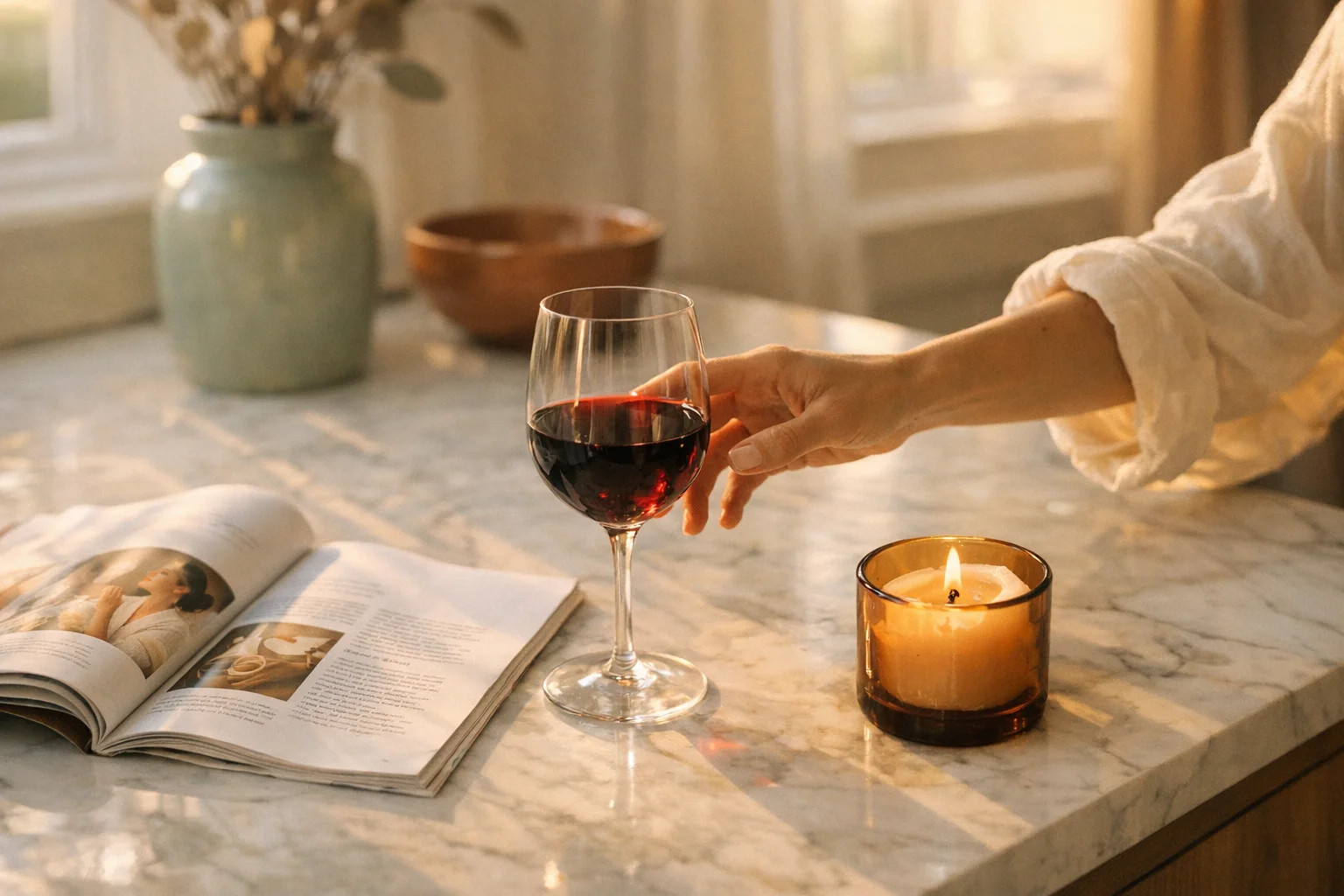
There is a particular issue of a wellness magazine on my counter from the year my third was born. The cover line was something like self-care for moms who give it all, and one photograph inside showed a glass of red wine, a bath, and an unlit candle arranged on a wooden tray. I cut out the page and put it on the fridge. The picture stayed up there for years. So did the idea behind it. I treated the wine glass and the bath as the same kind of thing, the same kind of input, the same restorative little gift to the end of a long day. I was wrong about that, and it took me a long time and a great deal of reading to understand why.
The Marketing of "Wine as Self-Care"
The phrase "wine as self care" did not arrive on its own. It was built. Beginning in the late 2000s, a wave of grocery-store wines was launched with names and labels that explicitly named motherhood as the buyer: MommyJuice, Mad Housewife, Mommy's Time Out. The bottles were positioned next to lifestyle imagery showing a woman alone at the end of the day, often in a kitchen, often in soft light, with the implication that the pour was the reward she had earned by getting through it.
That category did not invent the maternal drinking habit. What it invented was the pairing of the habit with wellness language. Books, magazines, and social-media captions in the early 2010s carried the same equivalence: bath, candle, wine. Stretching, cup of tea, glass of red. As if these were all the same kind of input.
A 2024 paper by Hill and Mazurek in Substance Use and Misuse surveyed 466 American and British mothers and found that engagement with this kind of wine-mom messaging correlated, at moderate to strong levels, with drinking-to-cope motives, parenting stress, and problematic alcohol use. The category and the symptom move together in the data. Some context lives at my longer write-up of mommy wine culture and how it landed where it did.
What Self-Care Actually Is, Biologically
Real self-care is regulation that aligns with the systems that keep a person rested and resourced. It does not have to be precious or expensive. The list is unglamorous. Sleep that is long enough and unbroken. Food that includes protein and fiber and is not eaten standing up. Movement that the body recognizes. Daylight, particularly in the morning. Connection with another adult. Quiet between tasks. A nervous system that gets to downshift before bed.
What ties these together is direction. Real self-care moves the body toward homeostasis. The autonomic nervous system shifts toward parasympathetic dominance. Cortisol drops the way it is supposed to drop in the evening. The sleep window opens cleanly. The next morning has a fair shot at being a morning, not a recovery.
A bath at 9 PM is self-care because of what it does to core body temperature and to the limbic state. A short walk after dinner is self-care because it nudges glucose, mood, and circadian timing all at once. A real conversation with a friend is self-care because the social engagement system itself is regulatory. The mechanisms are not mysterious. They are the kind of mechanisms you can read about in a physiology textbook.
The reason any of this matters is that wine does not do those things. Wine does the opposite, on a delay.
What Wine Actually Is, Biologically
A glass of wine is a precisely engineered way to reduce inhibitory signaling in the brain for about ninety minutes. Ethanol binds to GABA-A receptors, the major inhibitory receptor system in the central nervous system, and amplifies their effect. Within ten to twenty minutes, the prefrontal cortex quiets, the amygdala quiets, and the body experiences the change as relief.
That part is not controversial. Kumar and colleagues' 2009 review in Psychopharmacology documents the GABA-A receptor mechanism in detail and shows that with chronic nightly drinking, the receptor configuration changes. Some subunits are pulled out of the membrane. The same dose does less. The body adapts.
The cost of that adaptation is what the marketing left out. Becker and Mulholland's 2014 chapter in the Handbook of Clinical Neurology describes what happens when the GABA system has been chronically dampened by ethanol. The brain compensates with a hyperglutamatergic counter-state, increased excitatory NMDA receptor activity, and a generally tilted seesaw. As soon as the ethanol clears, that excitatory state is exposed. The body reads the swing as an emergency.
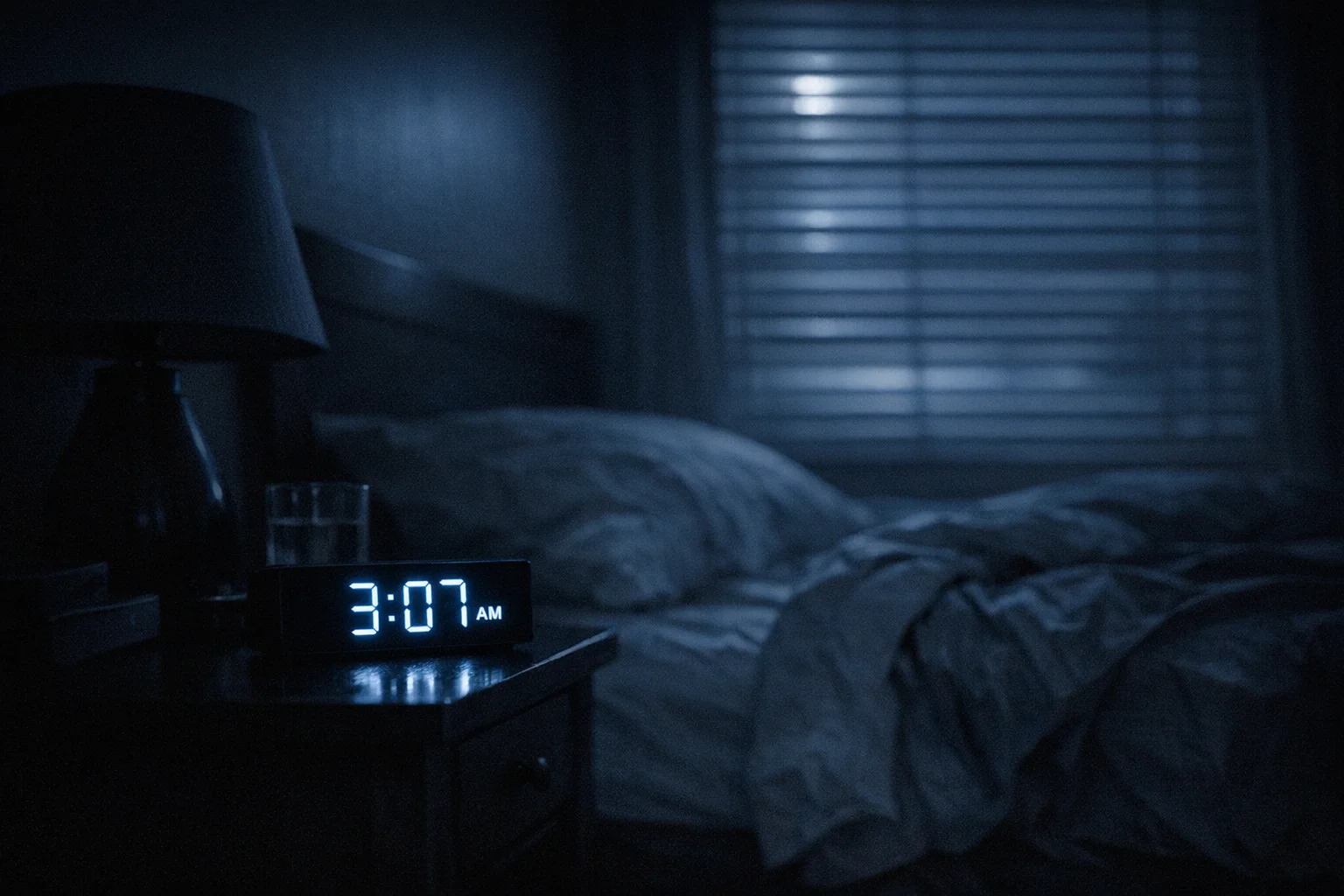
There is also a stress-axis layer. Stephens and Wand's 2012 review in Alcohol Research: Current Reviews documents the cortisol response to drinking. Acute alcohol raises cortisol, and with repeated nightly use the HPA axis becomes dysregulated. The early-morning cortisol pulse runs harder than it should. The 3 AM bedside heart rate is a downstream symptom of this combined picture.
What looks like a quiet little ritual at 5 PM is, biologically, a sedative pulse on a system that will pay back the calm with interest in the second half of the night.
Why the Relief Feels Real, and Why It Collapses by 3 AM
The relief is real. That is what makes the equation so durable. At 5:48 PM the kitchen is loud, the day's load is at its heaviest, cortisol is making its second daily peak, and the prefrontal resources for choosing well have already been spent. Twenty minutes after a pour, the body is measurably quieter. The brain is not lying about that.
What the brain is not telling you, in those same twenty minutes, is what it is doing to compensate. The hyperglutamatergic counter-response Becker and Mulholland describe begins building during the very hour the wine is providing relief. By the time the ethanol leaves the bloodstream, the seesaw is heavily weighted on the excitatory side, and the brain is left holding the imbalance through the second half of the night.
Ebrahim and colleagues' 2013 review in Alcoholism: Clinical and Experimental Research documents the sleep architecture cost. Even moderate alcohol delays the first REM episode and fragments the second half of the night. The 3 AM wake is not random. It is a chemical fingerprint. A longer write-up of why 3 AM specifically sits at the science layer. The morning after wine is the bill from the night before.
What Actually Does the Thing Self-Care Promised
The promise the wine bottle was making, the one that sold so many of them, was downregulation at the end of a long day. The promise was real. The substance was the wrong tool for it.
Most of what actually downregulates a nervous system at 5 PM is unglamorous and free. A short walk in late-afternoon light shifts cortisol within minutes and resets circadian timing. A glass of cold water with ice and lime in a real wine glass preserves the cue and the routine and replaces only the substance. A locked-door bath, when conditions allow, brings core temperature down through a peripheral vasodilation pathway that is the actual physiological lever the wine was vaguely imitating.
The trick is matching the tool to the moment. The 5 PM cue is not imaginary, and ignoring it does not work. Replacing what lands inside it does. A separate post that walks through five rituals I tested at exactly that hour covers the practical side. What I want to underline here is the conceptual move. The cue does not need to be denied. It needs a different ending.
That distinction is the one the marketing flattened. The body knows the difference.
What Flopped When I Tried to Swap
I want to be honest about one early swap that did not work. In the first months of paying attention to my drinking, I bought a small inventory of self-care objects intended to replace the wine ritual. A new candle, a weighted eye mask, an expensive face oil, a meditation app subscription. I lined them up on a shelf and treated them as the new ritual.
The whole structure flopped within three weeks.
The reason was mechanism. The wine ritual had a cue (5 PM kitchen), a routine (the pour), and a reward (the GABA pulse). The objects I had bought were not paired with the cue. None of them met me at 5:48 PM with a hand motion. The candle sat in the bedroom. The face oil belonged to the morning. The meditation app required me to sit down in a quiet room, which is the precise resource that hour does not have. The objects were lovely. They were arranged like a magazine spread instead of like a habit loop.
What worked, eventually, was paying attention to the cue and routine first and the substance last. The swap that took was a simple one, executed at the exact same minute, with the exact same hand motion. A longer arc on noticing the pattern at all sits adjacent to this one.
The Wine as Self Care Myth and What I'd Say Now
If a friend handed me that magazine cover today, I would say two things.
The first is that the equation is built on a category error. A glass of wine and a bath are not the same kind of input. They share an hour and a mood. They do not share a direction. One moves the body toward rest. The other moves it toward a delayed corrective. The marketing was effective because it ignored that distinction, not because it was right about it.
The second is that the body is unfailingly the source of truth. The 3 AM wake, the morning anxiety, the day-after fatigue, the slow erosion of the next afternoon's patience. These are not vague feelings. They are signals from a regulatory system that is paying interest on a loan it never meant to take. Pretending otherwise made it worse, in my experience. Naming the trade-off honestly is the first step toward something else.
Reframe was the app I had been working through during this stretch. The daily lessons covered GABA, glutamate, the stress axis, and the habit loop, and that material gave me a way to read my own brain instead of arguing with it. It is one option among several, and its self-reported outcome statistics are not peer-reviewed. SMART Recovery offers free CBT-anchored peer meetings online and in person. Annie Grace's Alcohol Experiment is a free 30-day cognitive-reappraisal program that pairs naturally with this kind of testing. Individual therapy with a qualified clinician is always a legitimate door. What worked for me may not work for you.
I write The Clear Mom because the equivalence I cut out of a magazine is the one a generation of mothers learned by heart, and the body is still keeping the receipt. Wine and a bath are not the same input. The version of this conversation that happens at a playdate is the social ground where the equation gets reinforced.
This post is written from personal experience and cites peer-reviewed research. It is not medical advice. If you're concerned about your drinking or your health, please speak with a qualified clinician.