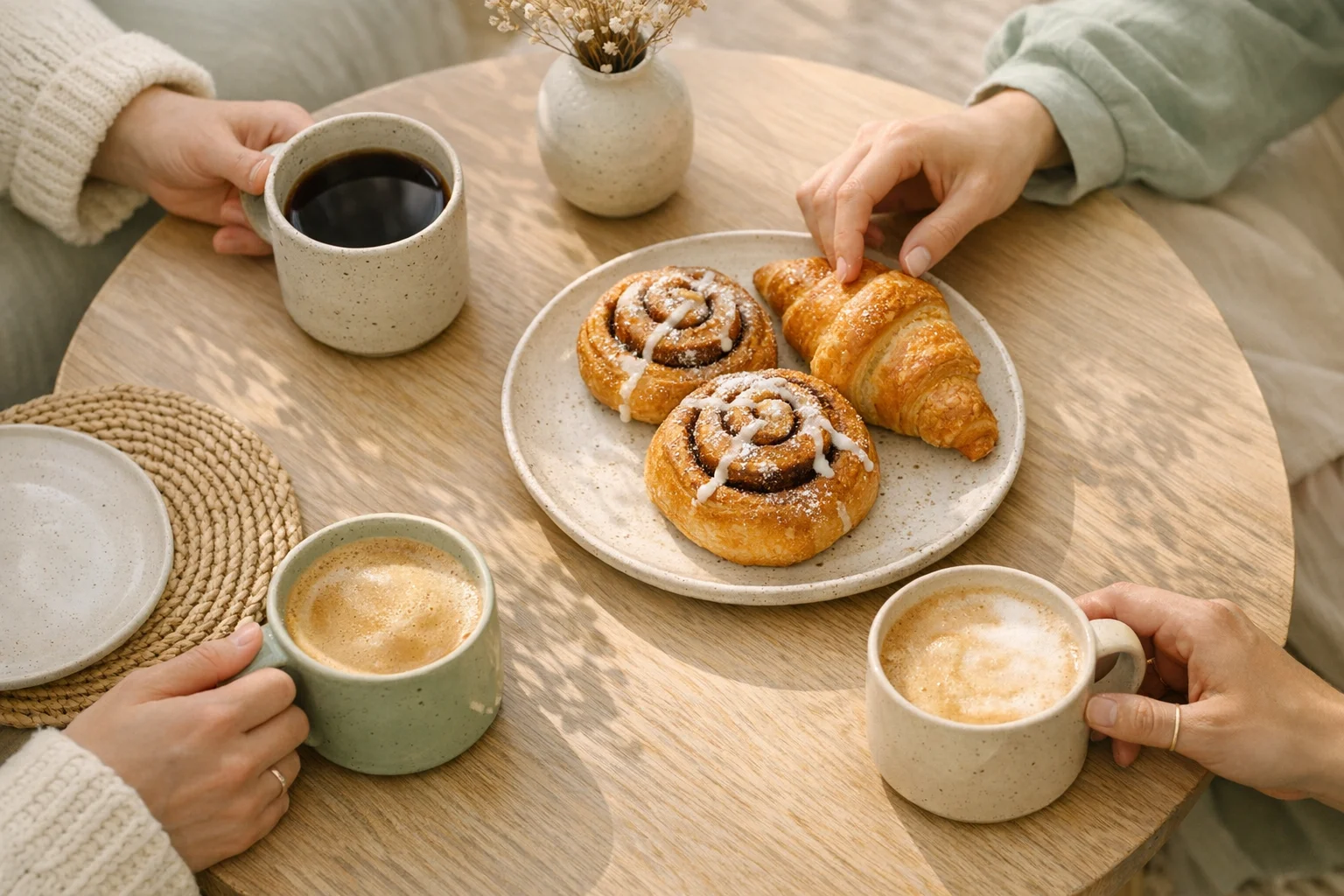
When you start drinking less as a mom, the hardest part often isn't the craving — it's the social pressure. From "just one glass!" at book club to wine being the default activity at mom's night out, navigating friendships while rethinking your relationship with alcohol requires real strategies. Here are practical, word-for-word scripts that work in the most common situations, along with how to handle the friends who push back — and how to find the ones who won't.
I'll tell you the moment I knew this was going to be an issue. I was three weeks into not drinking — feeling incredible, sleeping like a teenager, genuinely proud of myself — and I walked into my monthly book club. Within thirty seconds of arriving, someone handed me a glass of rosé. "Here, you need this," she said, laughing. "I saw on your Instagram that your kid had strep this week."
She was being kind. She was being a friend, in the way our friend group had always shown care: with wine. And I stood there holding a glass I didn't want, trying to figure out how to put it down without making it weird.
If that moment sounds familiar, this article is for you.
The Reality of Mom Social Life and Alcohol
Let's be honest about what we're dealing with. In many suburban mom circles, alcohol isn't just present at social events — it is the social event. "Wine night" is shorthand for getting together. "Moms who brunch" means mimosas. The class WhatsApp group jokes about "it's wine o'clock" by Thursday. A 2021 study in Substance Use & Misuse found that social norms within peer groups are among the strongest predictors of women's drinking behavior — stronger than individual risk factors or family history (Fairbairn & Kang, 2021).
This means that changing your drinking isn't just a personal choice. It's a social negotiation. And nobody hands you a script for that part.
Until now.
Why It Feels So Hard to Say No
Before we get to the scripts, it helps to understand why declining a drink feels so disproportionately difficult. It's not weakness. It's biology and sociology working together.
The belonging instinct. Humans are wired for social cohesion. When everyone in a group is doing the same thing — drinking — not participating triggers a primal discomfort. Neuroscience research on social exclusion (Eisenberger et al., "Does Rejection Hurt?" Science, 2003) shows that the brain processes social rejection in the same regions that process physical pain. Saying "no thanks" to a drink can feel, neurologically, like risking rejection.
The mommy wine culture permission structure. Our culture has built an entire narrative around moms and wine. It's the reward for surviving the day. It's the bonding agent for female friendship. Opting out can feel like rejecting the whole framework — like saying "I'm different from you" to women you want to feel close to.
The explanation trap. When you say no to a drink, people often want to know why. And any answer feels loaded. "I'm taking a break" invites "why?" "I'm trying to be healthier" sounds like a judgment. "I just don't feel like it" sounds suspicious. The social pressure to explain creates a secondary pressure that makes the whole thing feel bigger than it is.
So: here are the phrases that cut through all of that.
10 Scripts That Actually Work
I've tested these. Other moms I know have tested these. The best scripts share three qualities: they're short, they're confident, and they don't invite debate. Pick the ones that feel natural to you.
The Casual Deflection (best for acquaintances and large groups)
1. "I'm good, thanks!" — Said while already holding a non-alcoholic drink. The simplest, most effective script. No explanation. No opening for follow-up. The drink in your hand signals that you're not deprived — you've already got what you want.
2. "I'm driving tonight." — Inarguable. Universal. Nobody questions it. Even if you could technically have one glass and drive safely, nobody is going to debate this one. Make yourself the designated driver and the question disappears entirely.
3. "Not tonight — but I'd love a sparkling water if you have one." — This one works because it redirects the conversation to what you do want instead of what you don't. It gives the host something to do (get you a drink) while moving past the moment.
The Health Frame (best for closer friends who might ask follow-up questions)
4. "I'm doing a 30-day experiment — just seeing how I feel." — The word "experiment" is powerful. It signals curiosity, not crisis. It's temporary-sounding, which reduces social threat. And it gives you a built-in conversation topic if someone asks how it's going. Many women who start with a "30-day experiment" end up extending it once they feel the changes.
5. "I've been sleeping so much better without it — I'm not ready to give that up." — Framing your choice in terms of what you're gaining, not what you're giving up. This is also genuinely compelling to other moms who are exhausted, because most of them are.
6. "My doctor suggested I take a break." — This is the nuclear option for persistent pushers. Nobody argues with a doctor. You don't need to elaborate. It doesn't matter if the "doctor" is you after reading about how alcohol affects you after 35.
The Redirect (best for changing the subject entirely)
7. "I brought this amazing NA drink — have you tried it?" — Bringing a non-alcoholic option you genuinely like shifts the dynamic from "Amy's not drinking" to "Amy brought something interesting." Curiosity-driven. It's also how I discovered that most of my friends are curious about NA drinks but have never actually bought one. (Here's my list of favorites.)
8. "I actually wanted to ask you about [completely unrelated topic]." — Sometimes the best response to an awkward moment is to simply not engage with it. Accept the glass if you need to (you can hold it without drinking it), and redirect the conversation. People care less about what's in your cup than you think.
The Honest Version (for your actual close friends)
9. "I've been rethinking my drinking and I feel so much better. I'd love your support." — This is for your inner circle. The friends who matter most. Vulnerability creates connection, and most close friends will rise to the occasion. The key phrase is "I'd love your support" — it gives them a role to play and makes them an ally rather than a bystander.
10. "I realized it wasn't doing what I thought it was doing for me." — This is my personal go-to. It's honest without being heavy. It doesn't moralize. It doesn't imply that anyone else should change. It simply describes your own experience. In my experience, this one generates the most genuine, curious conversations.
When Friends Push Back
Most friends, when met with a confident "no thanks," will move on. But some won't. And it's worth being prepared for the different flavors of pushback.
The Minimizer: "Oh come on, one glass won't hurt." This person isn't trying to undermine you. She's trying to preserve normalcy. Your response: a warm smile and "I know — I just feel better without it right now." Repeat as needed. Don't argue the point. You don't have to convince her.
The Interrogator: "Why? Are you pregnant? Are you doing a cleanse? Did something happen?" This person is genuinely curious but doesn't realize she's being invasive. Your response: "Nothing dramatic — just paying more attention to how it affects me." If she keeps going, it's okay to say, gently, "I appreciate the concern, but I don't really want to make it a whole thing."
The Offended One: "So you think you're better than us now?" This is the hardest one, and it's almost always about her own stuff, not yours. Psychologists note that when one person in a social group changes a shared behavior, others can experience it as an implicit criticism — even when none is intended. Your response: "Absolutely not. I love hanging out with you. I'm just trying something different for myself." Keep it warm. Keep it about you. Don't take the bait.
The Persistent Offerer: The friend who keeps putting drinks in front of you even after you've declined. This one requires a direct conversation, ideally one-on-one, outside the social setting: "Hey — I need you to hear me when I say I'm not drinking right now. I know you're being generous, but it's actually harder for me when you keep offering. Can you just trust me on this one?"
The vast majority of friendships survive this adjustment. The ones that don't were probably built more on the shared drinking than on genuine connection.
Finding Your People
One unexpected gift of drinking less was discovering how many other moms were already thinking about it. They just weren't talking about it. Once I opened the door a crack — a casual mention at pickup, an honest moment at coffee — other women started telling me their own versions of the same story.
If you're looking for community beyond your existing friend circle, there are some genuinely good options:
- Morning meetup groups. Hiking groups, early workout classes, Saturday morning coffee — any social setting that's inherently incompatible with drinking tends to attract people who are interested in connecting without alcohol.
- Online communities. App-based programs like Reframe have built-in community features where you can connect with other women going through the same thing. I found these especially helpful in the early weeks when I needed to feel less alone at 6 PM on a Friday.
- The friend who "gets it." Almost every woman I know who has rethought her drinking has at least one friend who, when she opened up about it, said some version of "Oh my god, me too." Find that friend. Text her on the hard afternoons. Be that friend for someone else.
You Don't Owe Anyone an Explanation
I want to end with the thing I wish someone had said to me at that first alcohol-free book club, standing there holding a glass of rosé I didn't want:
You don't owe anyone an explanation for taking care of yourself.
You don't need a dramatic reason. You don't need a diagnosis. You don't need to justify it. You're allowed to change a habit simply because you want to see what happens when you do.
The friends who love you will adjust. The ones who pressure you are dealing with their own stuff. And the women who notice your change and get quietly curious? They're the ones who might need to hear your story most.
If you're just starting to think about this, the Start Here page is a good place to begin. You don't have to figure it all out tonight. You just have to get through tonight.