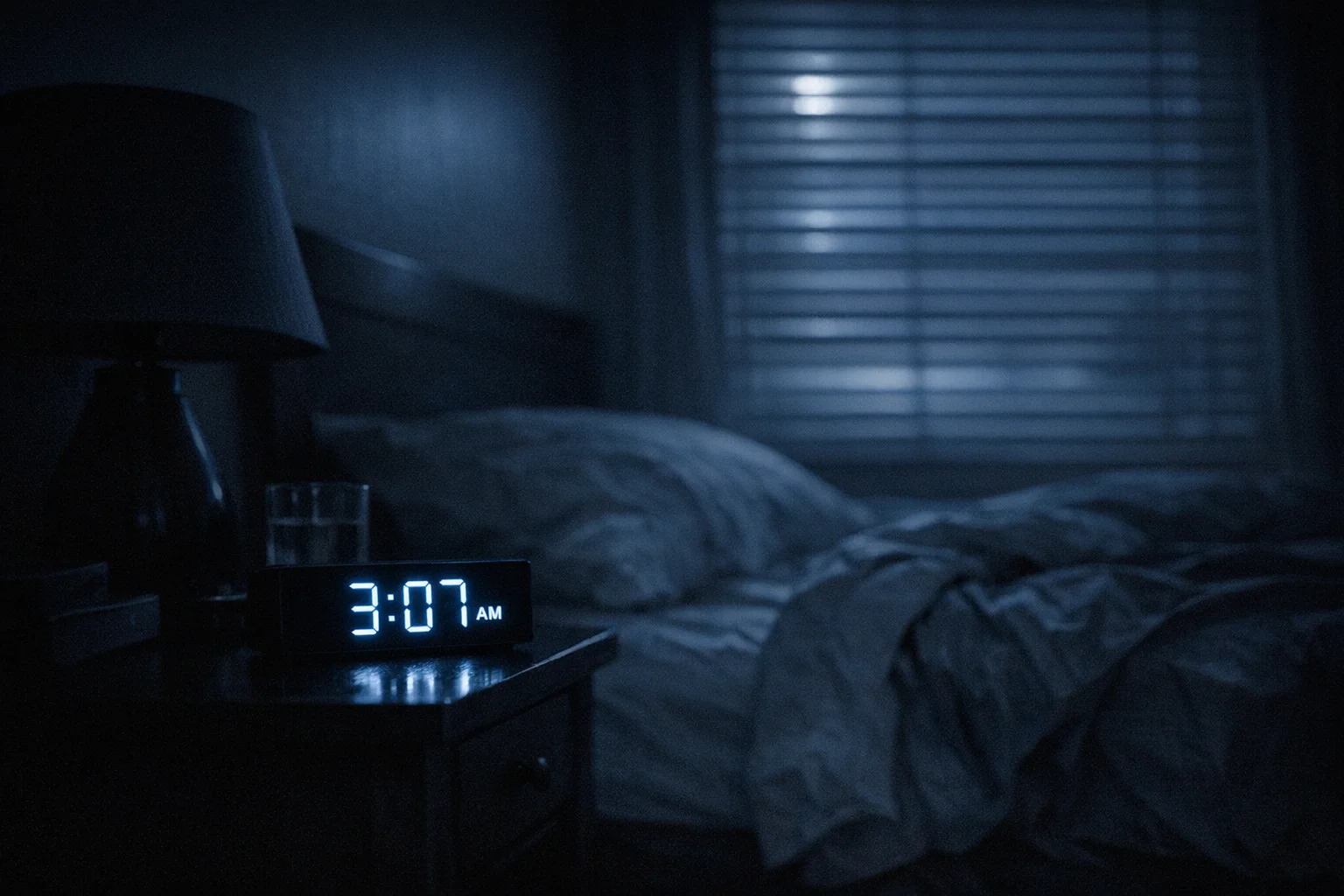
You wake up at 3am after drinking because two neurochemical pathways fire at the same time. First, your brain rebounds from alcohol's sedative effects by flooding your nervous system with glutamate, the excitatory neurotransmitter it had been suppressing all evening. Second, your HPA axis releases a premature cortisol spike as the physiological stress of alcohol metabolism activates your body's central stress-response system. These two pathways converge roughly 3 to 4 hours after your last drink, producing the racing heart, the anxious alertness, and the inability to fall back asleep that millions of people experience in the middle of the night.
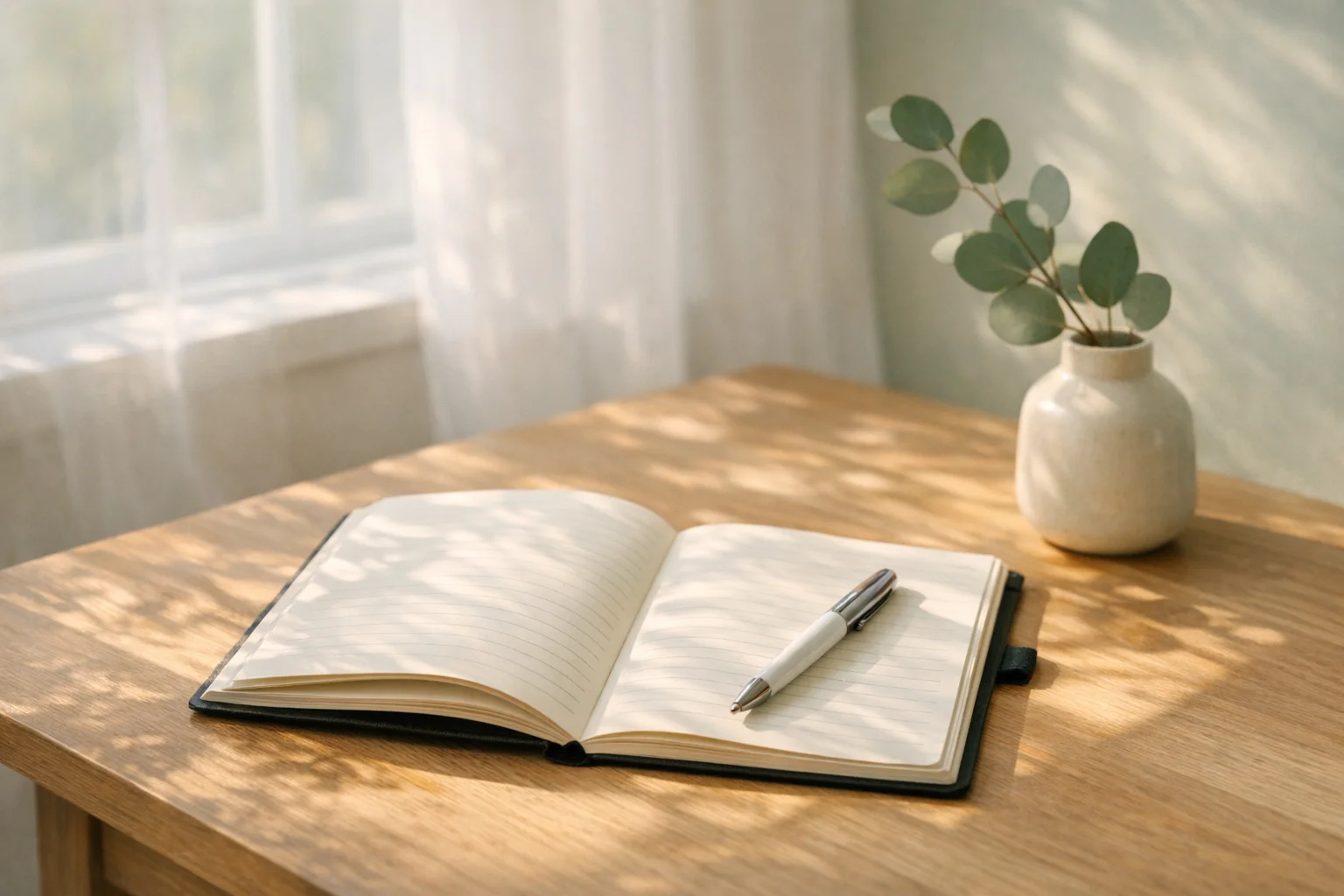
I kept a notebook on my nightstand for two weeks in February 2026. Not a gratitude journal or a sleep log. Just a small spiral-bound pad where I wrote down what I was feeling each time I woke up in the dark. The entries on drinking nights were almost identical: "3:07. Heart pounding. Already thinking about the school fundraiser email. Wide awake. Legs restless. Tried to close my eyes for ten minutes. Nothing." The entries on alcohol-free nights were mostly blank, because I slept through.
That notebook was what finally made me stop pretending the 3am wakeups were random. They weren't random. They followed a neurochemical script that, once I understood it, I could predict down to the hour. Here's that script.
What Alcohol Actually Does to Your Brain (The First 2 Hours)
When you drink a glass of wine or any alcoholic beverage, ethanol crosses the blood-brain barrier within minutes and alters the balance between your two most important neurotransmitter systems. It enhances GABA-A receptor activity (your brain's primary calming system) while simultaneously blocking NMDA glutamate receptors (your brain's primary excitatory system). Koob and Volkow described this dual action in their 2016 review in The Lancet Psychiatry as the neurochemical foundation of alcohol's acute effects.
The result is a wave of neural inhibition. Your muscles relax. Your thoughts slow. The low hum of anxiety that followed you through the afternoon fades. If you fall asleep during this window, you'll drop into deep slow-wave sleep faster than usual. Ebrahim et al. (2013) found in their review in Alcoholism: Clinical and Experimental Research that alcohol at all doses increases deep sleep in the first half of the night and reduces how long it takes to fall asleep.
This is the part that fools us. The first two hours of alcohol-affected sleep look great on a sleep tracker. I used to point to my Oura ring data and tell myself the wine was helping me sleep, because those early hours always showed an impressive block of deep sleep.
But your brain noticed what happened. And it started adjusting before you finished your second glass.
The Glutamate Rebound: Why Your Brain Snaps Awake
Your brain is devoted to maintaining its excitatory-inhibitory balance. When alcohol artificially boosts GABA and suppresses glutamate, the brain compensates: it reduces GABA receptor sensitivity and upregulates NMDA glutamate receptors. Becker and Mulholland documented this mechanism in their 2014 review in the Handbook of Clinical Neurology, describing the resulting "hyperglutamatergic state" that emerges as alcohol clears the system.
While you're still under the influence, these compensatory changes are masked. You don't feel them. But as your liver clears ethanol at roughly one standard drink per hour, the masking effect lifts. The GABA enhancement fades. The glutamate suppression ends. And your brain is left sitting with upregulated excitatory receptors and downregulated calming ones, tipped hard toward hyperexcitability.
This is the glutamate rebound. It doesn't announce itself gently. It snaps you awake with what feels like an adrenaline surge. Your heart rate jumps. Your mind begins spinning through thoughts at a pace that feels electric. Every small noise in the house sounds amplified.
The anxiety that accompanies this state is not psychological in origin; it's neurochemical. Your amygdala is being driven by excitatory signals that your prefrontal cortex can't override, because that region is still impaired from the alcohol's residual effects. For a deeper look at how this rebound feeds the anxiety-drinking cycle over time, I wrote about the anxiety-drinking cycle and how it compounds over time.
The Cortisol Spike: Your Stress System Joins the Party
The glutamate rebound alone would be enough to wake you. But a second system fires at roughly the same time.
Your HPA axis (hypothalamic-pituitary-adrenal axis) controls cortisol release on a tight circadian schedule. In normal sleep, cortisol drops to its lowest point in the late evening and early night, then rises gradually through the pre-dawn hours, peaking shortly before your natural wake time.
Alcohol disrupts this timing. Stephens and Wand (2012), writing in Alcohol Research: Current Reviews, documented that alcohol activates the HPA axis and produces elevated cortisol levels that arrive hours earlier than the natural circadian rise. Blaine et al. (2016), in the Canadian Journal of Psychiatry, found that acute alcohol consumption increases blood cortisol, norepinephrine, and other stress hormones, with the effect most pronounced as blood alcohol levels are falling.
So around the same time your glutamate system is rebounding, your HPA axis releases a premature cortisol spike. Two alarm systems, driven by separate mechanisms, going off simultaneously. One is excitatory (glutamate flooding hypersensitive receptors). The other is stress-activating (cortisol mobilizing your fight-or-flight response). Together they produce that distinctive 3am experience: you're not just awake, you're wired. Your heart is racing. Your mind is churning. And sleep feels physically impossible even though you're exhausted.
Hour-by-Hour: What Happens from Last Sip to 3am
Here's how this plays out on a clock, using a scenario most evening wine drinkers will recognize: two glasses with dinner, last sip at 8:30 PM, lights out at 10:30 PM.
8:30 PM (Hour 0): The last sip. Your blood alcohol concentration (BAC) is near its peak. GABA activity is enhanced. Glutamate is suppressed. You feel warm, relaxed, and pleasantly drowsy. Your liver begins processing ethanol at approximately 0.015% BAC per hour.
10:30 PM (Hour 2): You fall asleep. Fast. Alcohol's sedative effect drops you into deep slow-wave sleep within minutes. Your sleep tracker shows an impressive block of N3. But your first REM period, which should arrive around midnight, is delayed or suppressed entirely. Gardiner et al. (2025) found in their meta-analysis of 27 studies that alcohol at all doses delays REM onset and reduces REM duration.
12:30 AM (Hour 4): BAC is falling fast. Your liver has metabolized roughly half the alcohol. The compensatory changes (GABA downregulation, glutamate upregulation) are still in place, but the alcohol masking them is disappearing. You may shift from deep to lighter sleep stages without fully waking. Your heart rate, suppressed by the sedative effect, begins climbing.
2:00 AM (Hour 5.5): The glutamate rebound begins. BAC approaches zero. The hyperglutamatergic state kicks in. NMDA receptors, hypersensitive from hours of being blocked, are suddenly unmasked. Excitatory signaling surges.
2:30 to 3:30 AM (Hours 6 to 7): The convergence. Glutamate rebound peaks. HPA axis fires its premature cortisol release. These two events, driven by separate mechanisms, land in the same window. You snap fully awake. Heart racing. Thoughts spinning. A sense of dread disconnected from anything happening in your actual life.
3:30 to 6:00 AM (Hours 7 to 9.5): Fragmented light sleep. You may drift back eventually, but only into N1 and N2 stages. The REM-rich sleep that should dominate this window is truncated and fragmented. The alarm goes off at 6:30 and you feel worse than if you'd slept six hours without wine.
Why 3am? The Math Behind the Timing
The reason so many people wake up at almost exactly 3am is not mystical. It's arithmetic.
A standard glass of wine (5 oz at 12% ABV) produces roughly 0.03 to 0.04% BAC in an average-weight woman, partly because women have lower gastric alcohol dehydrogenase activity, as Frezza et al. documented in their landmark 1990 study in the New England Journal of Medicine. Two glasses bring you to approximately 0.06 to 0.08%.
Your liver clears alcohol at a fixed rate of approximately 0.015% BAC per hour. From a peak of 0.07% around 9 PM (roughly 30 minutes after your last sip), reaching near-zero takes about 4.5 to 5 hours. That puts you at 1:30 to 2:00 AM.
But the glutamate rebound and cortisol spike don't wait for BAC to hit absolute zero. They begin as BAC falls through the threshold where alcohol can no longer mask the brain's compensatory adjustments. In practice, this happens when BAC drops below roughly 0.02%, which for our two-glass scenario arrives between 1:00 and 2:00 AM, with full rebound peaking 30 to 60 minutes later.
Add it up: last drink at 8:30, peak BAC around 9:00, critical threshold near 1:30 AM, full rebound convergence at 2:30 to 3:00 AM. Three glasses pushes the peak higher and the convergence closer to 3:30 or 4:00 AM. The "always 3am" pattern exists because most evening drinkers follow remarkably similar schedules, and the liver's metabolic rate is nearly identical across individuals.
Why Wine Seems Worse
If you've noticed that wine specifically seems to produce worse 3am wakeups than beer or cocktails, you're not imagining it. But the reason isn't what most people think.
The ethanol in wine, beer, and spirits is chemically identical. A 5 oz glass of wine at 12% ABV contains the same ethanol as a 12 oz beer at 5% or a 1.5 oz pour of spirits at 40%. At equivalent doses, the sleep disruption is equivalent. Ebrahim et al. (2013) found no meaningful difference in sleep architecture disruption between beverage types.
Wine feels worse for three reasons, and none of them involve the ethanol molecule itself.
First, pour size. Wine glasses in most American homes hold 7 to 10 ounces, not 5. A "glass" of wine poured at home is often 1.5 to 2 standard drinks. Two "glasses" at dinner may actually be three or four standard drinks, pushing your BAC significantly higher than you'd estimate.
Second, sipping pace. Wine is consumed slowly over a meal or an evening, which spreads absorption and can push peak BAC later. A cocktail consumed in 20 minutes peaks faster and starts clearing sooner. Wine consumed over two hours peaks later, delaying the rebound and pushing the convergence point into deeper sleep phases, which makes the wakeup feel more abrupt.
Third, the ritual. For many mothers, wine carries associations that beer and spirits don't. The pour while making dinner. The second glass after the kids are down. The consistency of this pattern means wine drinkers hit the exact same metabolic timeline night after night, reinforcing the 3am wakeup as an almost guaranteed outcome rather than an occasional event.
What to Do Right Now (If You're Reading This at 3am)
If you found this article because you're lying awake right now, here's what to know: what you're experiencing is a neurochemical event, not a personal failing. Your brain is in a temporary state of hyperexcitability, and it will pass. Here is what helps right now.
Don't check the clock again. You already know the time. Clock-watching activates your prefrontal cortex (calculating how many hours until the alarm, planning tomorrow, dreading the fatigue) and reinforces the arousal state. Turn the clock away or cover it.
Breathe on a count. Box breathing (inhale 4 counts, hold 4, exhale 4, hold 4) activates your vagus nerve and shifts your autonomic nervous system toward parasympathetic dominance. This won't eliminate the glutamate rebound, but it directly counters the cortisol-driven sympathetic activation. Four to six cycles is usually enough to feel a shift.
Cool your body. Push the covers off or stick one foot out from under the blanket. Your core body temperature is likely elevated from cortisol and alcohol metabolism. A slight drop in skin temperature signals your hypothalamus that it's still nighttime.
Don't reach for your phone. Blue light suppresses melatonin and activates alertness circuits. If you need something to occupy your racing mind, try a boring mental task: count backward from 300 by threes, or name a city for every letter of the alphabet.
Drink water. Alcohol is a diuretic, and dehydration compounds the physiological stress your body is already processing. A glass of water won't fix the glutamate rebound, but it reduces one layer of the discomfort.
Accept the next 30 to 45 minutes. The glutamate rebound typically peaks and begins subsiding within that window. Knowing this timeline can reduce the "I'll never fall back asleep" panic that amplifies the arousal. You will likely drift back into light sleep once the acute excitatory surge passes.
I wrote many of those nightstand notebook entries at 3am. The single most useful thing I learned was to stop fighting the wakeup and start observing it. Telling myself "this is glutamate and cortisol, it peaks in about 45 minutes" didn't knock me out, but it stripped away the catastrophic edge. The panic about being awake is often worse than the wakeup itself.
How to Stop Waking Up at 3am After Drinking
The most reliable prevention is also the simplest: skip the drink. Every mechanism in this post starts when ethanol crosses the blood-brain barrier. No ethanol, no GABA disruption, no compensatory glutamate surge, no premature cortisol spike. The 3am wakeup doesn't happen.
If you're not there yet (and I wasn't, for a long time), here are strategies that reduce the severity.
The 3-hour minimum. Stop drinking at least 3 hours before bed. This gives your liver a head start on clearing ethanol and shifts the rebound earlier, when you may sleep through it. This is harm reduction, not a cure. Gardiner et al. (2025) found that alcohol at all doses disrupts REM regardless of timing.
One drink, not two. The dose-response is steep. The difference between one standard drink and two is not double the disruption; the metabolism timeline extends and the compensatory mechanisms activate more aggressively at higher doses.
Eat a substantial meal. Food slows alcohol absorption, lowers peak BAC, and moderates the rate at which rebound mechanisms engage.
Hydrate before bed. Water won't prevent the glutamate rebound, but it reduces the dehydration-driven stress that compounds it.
Track the pattern. Roehrs and Roth (2001), in their review for the National Institute on Alcohol Abuse and Alcoholism, documented that tolerance to alcohol's sedative effects develops within just three consecutive nights. If you drink most evenings, the sedative "benefit" vanishes while the rebound cost stays constant. Noticing which nights produce 3am wakeups (and which don't) makes the connection impossible to ignore. For the full picture of how alcohol reshapes your entire night of sleep beyond the 3am wakeup, I wrote about the hour-by-hour architecture in how alcohol affects sleep architecture.
When It's More Than Just Last Night's Wine
A once-in-a-while 3am wakeup after a dinner party is the mechanisms I've described playing out in a single night. Your brain rebounds, you lose some sleep, you recover.
But if you're waking at 3am most nights, or if the wakeups are getting worse even though your drinking hasn't increased, that's worth paying attention to. Anker and Kushner (2019), writing in Alcohol Research: Current Reviews, found that drinking specifically to cope with negative affect (using wine to manage evening anxiety, for instance) is one of the strongest predictors of escalating alcohol problems.
The kindling effect also applies here. Each cycle of alcohol sedation followed by glutamate rebound progressively sensitizes your brain's excitatory circuits. The same two glasses that produced mild restlessness a year ago may now produce full 3am panic, not because something new is wrong, but because repeated cycles have shifted your excitatory baseline upward.
Colrain, Nicholas, and Baker (2014) documented in the Handbook of Clinical Neurology that sleep disruption from chronic drinking persists into early abstinence but begins normalizing within one to two weeks. Most people see the 3am wakeups stop around day 10 to 14. By 30 days, sleep architecture has substantially recovered. For the full recovery timeline, see what happens to your brain after 30 days without alcohol. For the wider picture of why these wakeups also reshape next-day anxiety and the evening pull toward wine, see our pillar on the alcohol, anxiety, and sleep loop.
I started writing about this on The Clear Mom because the 3am wakeup was the thing that finally made the science personal for me. It wasn't the research papers that changed my behavior. It was lying awake at 3:07 AM, knowing exactly why it was happening, and deciding I was tired of the predictability. Around that time, I tried the Reframe app because it felt like a way to understand my own brain rather than fight it. The 160-day neuroscience curriculum treated these mechanisms as things worth learning about, not things to be ashamed of. That reframing mattered more than willpower ever did, though your path to paying attention may look different.
This post is written from personal experience and cites peer-reviewed research. It is not medical advice. If you're concerned about your drinking or your health, please speak with a qualified clinician.