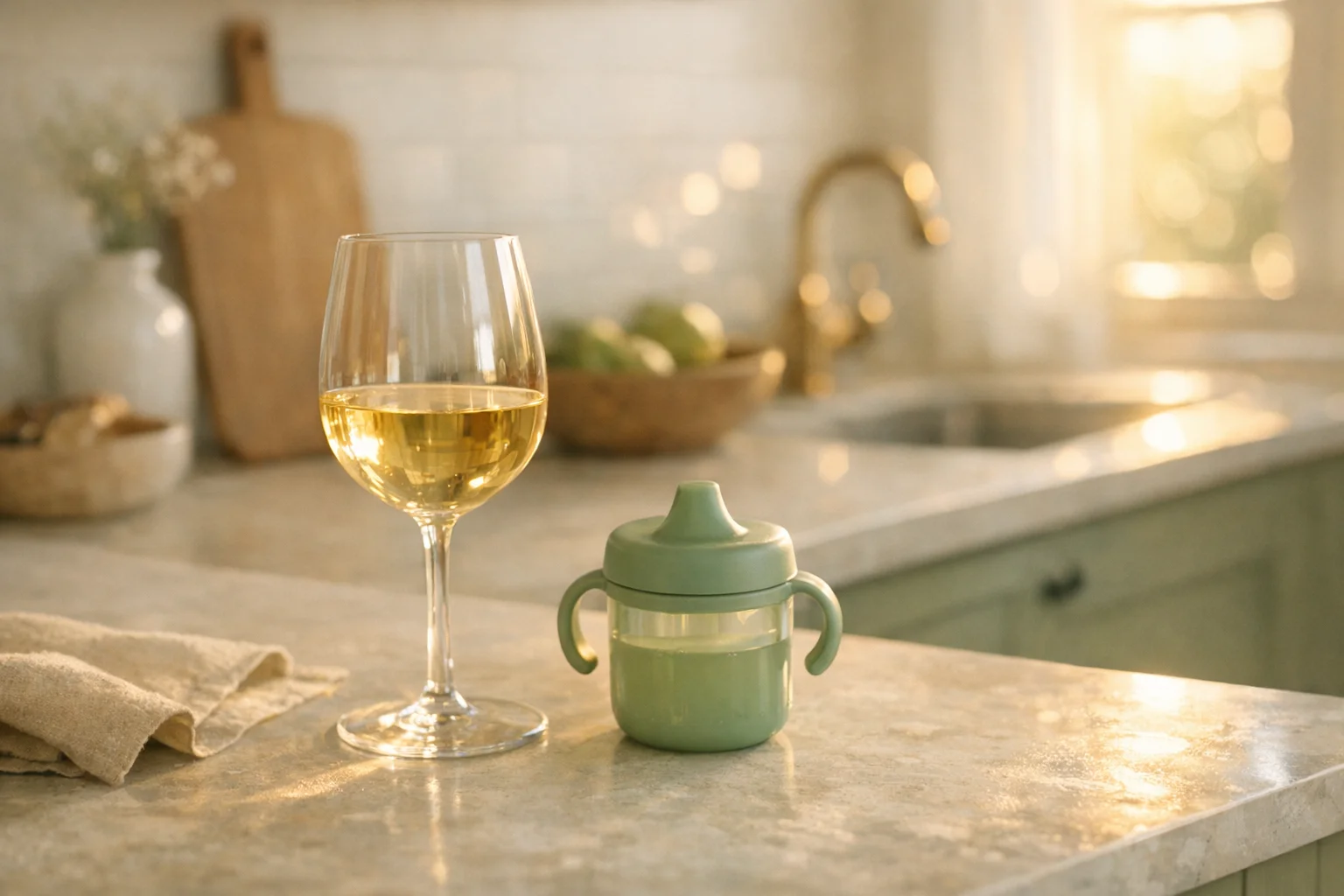
Moms who quit drinking can almost always name the moment the habit cracked open. Five common moments show up across the research and across the kitchens I have stood in: the 5 P.M. bell that stops working, the night a kid gets the worst of it, the 3 A.M. wake-ups, perimenopause changing the math, and someone close finally saying it out loud.
The mothers I know who quit drinking did not quit because of a brochure or a lecture. Almost all of them quit because of a moment. They can usually still tell you the date.
I have been writing The Clear Mom for long enough now to have heard versions of these five moments more times than I can count. They are not the same story. They are five recognizable stories, and each one has peer-reviewed research behind it that explains why the moment lands the way it does.
The five composite mothers below (Kate, Jess, Maya, Beth, and Ana) are not single people. Each one stands in for the version of that moment I have heard most often, edited together so the patterns are visible without anyone being identifiable. The research, however, is exact and named.
The 5 P.M. Bell: When the Wine Stops Working
Kate is 38, an HR director, mother of two. Her quit-decision moment was a Tuesday in the kitchen at 5:14 PM. She had not made it to 5:30. She had made it to 5:14. Six months earlier she had been making it to 6:00 most nights. She watched her own hand pour, and the small accounting voice in her head went quiet.
That voice going quiet is the moment, not the pour itself. The pour itself she had done a thousand times. What had changed was that her own attention had finally caught up to it.
A 2021 Swiss study by Kuntsche and Kuntsche, in Addictive Behaviors, looked at parents of preschool-aged children and asked whether work-family conflict drove coping-motivated drinking. In mothers, it did. The pathway from conflict to risky single-occasion drinking was fully mediated by drinking-to-cope motives. In fathers in the same households, with comparable conflict scores, the pathway was not present. The drinking-to-cope channel was specific to mothers.
What that finding makes legible: the 5 P.M. bell is not the wine doing the work. It is the structure of motherhood asking the wine to do work it cannot keep doing forever. At some point the math stops working. The pour gets earlier. The voice in your head gets quieter. That is the moment.
Snapping at a Kid: The Shame Spiral
Jess is 41, a part-time bookkeeper, mother of three. Her quit-decision moment was a Wednesday after dinner. She had been on her second glass when her seven-year-old asked the same question for the fourth time, and she snapped. The look on his face stayed with her after she had apologized, after he had been put to bed, after the third glass that came after the apology.
The shame loop after a moment like that has a recognizable shape in the literature. Hill and Mazurek's 2024 cross-sectional survey of 466 American and British mothers, in Substance Use and Misuse, found that wine-mom-culture exposure correlated, at moderate-to-strong levels, with both drinking-to-cope motives and parenting stress. The correlation is not causal. It is, however, exactly the loop most mothers describe inside their own kitchens. Stress drives drinking. Drinking erodes the patience that the stress was already taxing. The next snap arrives faster. Another pour follows.
Jess's quit-decision moment was not the snap itself. It was watching herself reach for the third glass after the apology, and recognizing that the third glass was about her, not about her son. The third glass became the moment because it was honest in a way the first two had not been.
Waking at 3 A.M.: When the GABA Math Stops Working
Maya is 39, a nurse, mother of one. Her moment came at 3:14 A.M. on a Thursday in February. She had stopped being able to make it through to morning. She had been waking at 3 A.M., sometimes 2:45 A.M., sometimes 3:30 A.M., with her heart pounding. She had been telling herself it was the perimenopause, the hospital schedule, the kid. It was also the wine.
The mechanism is well documented. Kumar and colleagues' 2009 review in Psychopharmacology of GABA-A receptor plasticity showed that chronic nightly drinking changes receptor configuration over time. Specific subunits internalize. The same pour does less. The brain compensates.
Becker's 2014 chapter in the Handbook of Clinical Neurology explains the cost of that compensation. As alcohol clears in the back half of the night, inhibitory signaling under-functions while the excitatory side keeps firing. The brain enters what Becker calls a hyperglutamatergic state. The result, on a body level, is the racing-heart wake-up at 3 A.M. and the next-day baseline anxiety that mothers describe almost identically.
For Maya, the quit-decision moment was the night she counted the 3 A.M. wake-ups for the previous month and got to nineteen. The arithmetic did the work no warning label had done. The longer write-up of why this happens at exactly 3 A.M. after drinking sits underneath this section for the reader who wants the full mechanism.
Perimenopause Changes the Math
Beth is 45, a graphic designer, mother of two teenagers. Her quit-decision moment was a Sunday morning that did not feel right. She was used to mild Sunday hangovers from a Saturday glass and a half, but this one was different. The hot flashes had returned overnight. The brain fog had returned. The mood drop had returned. She had been managing all of those most of the year. The Saturday wine had quietly torpedoed everything she had been managing.
Davies and colleagues' 2025 paper, among the most current and durable academic syntheses on women's mid-life alcohol use, examined the intersection of menopause symptoms, drinking behavior, and mental health in 936 women aged 40 to 65. Perimenopausal women, specifically, reported the highest menopause symptom load, the worst mental health, the lowest wellbeing, and the strongest negative-reinforcement drinking motives. Coping motives partially mediated the link between symptom severity and hazardous drinking. The peri-menopausal window was, in their analysis, a distinct risk window for the kind of drinking that was already trying to manage too much.
For Beth, the quit-decision moment was the recognition that the wine was no longer paying her back. It was making everything she was already trying to manage harder. The longer pillar on perimenopause and alcohol after 35 lays out the five hormonal shifts behind that math.
When Someone Close Names It: The External Mirror
Ana is 43, a marketing director, mother of three. Her quit-decision moment was a sentence from her husband on a Tuesday after the kids were asleep. He had said it carefully. He had said it once. Something like, I have been thinking about your drinking, and I love you, and I want to be honest about what I am noticing. She had been ready to be defensive. What she did instead was sit down.
Ana's husband was not the first person to notice. He was the first person whose noticing she could not deflect. The external mirror, when it finally arrives, often comes from the partner, sometimes from a sister, occasionally from a long-time friend.
Patsouras, Wright, Caluzzi, and colleagues' 2025 systematic review in Drug and Alcohol Dependence, titled Dissolving Contradictory Demands: A Systematic Review of Alcohol Use of Working Mothers, synthesized 22 studies of working mothers in high-income countries. The review's central finding was that working mothers drink at higher per-occasion quantities than comparable groups of midlife women, and that alcohol functions as a mechanism for managing structural contradictions between paid and unpaid labor. The review also documented that working mothers' drinking is often invisible to immediate networks until someone close finally names it.
For Ana, the quit-decision moment was her husband's careful sentence. The actual mechanism was that she had stopped being able to argue with what he had named. The longer write-up of the burnout-and-alcohol intersection at the science layer tracks why the drinking gets less visible to its own owner first.
What These Five Moms Who Quit Drinking Have in Common
The five moments are different on the surface. Kate's was a clock. Jess's was a face. Maya's was a count of nights. Beth's was a Sunday morning. Ana's was a sentence.
Underneath, all five are the same shape. A maternal coping cycle that had been working well enough for years ran into a structural break. The break could be biological (Maya, Beth), interpersonal (Jess, Ana), or simply the slow drift of an arithmetic that had finally outrun what the drinker could rationalize (Kate). In every case the moment was the moment the rationalization stopped.
The other thing the five moms who quit drinking have in common is that none of their moments was a crisis. None of these mothers was passed out, lost a job, or got pulled over. They were all functioning. They were also all, at the same time, paying attention to a quiet question they had been carrying for months or years. The moment is when the attention catches up to the answer.
Why Mothers Specifically Get Stuck
This is the hardest paragraph to write because it is also the most important. The 2021 Kuntsche and Kuntsche finding is the single most useful sentence I have read on this whole topic. Same household. Same dual-earner pressure. Same kids. Same evening hours. The mothers' drinking lined up with the work-family conflict score. The fathers' did not.
What that finding suggests, structurally, is that the maternal load is doing something to the relationship between stress and coping-motivated drinking that the paternal load is not. The most likely reasons are that the unpaid caregiving load lands harder on mothers in the same homes, that the cultural script around acceptable male unwinding is different, and that the wine-mom marketing apparatus has spent twenty years specifically training mothers, not fathers, to use alcohol as the evening's reset.
This is why a mom asking why can't I just stop is usually asking the wrong question. The question is not why she cannot stop. The question is why this particular tool has been so heavily prescribed to mothers in particular, and what could fill the function the prescription was filling. Once the function is named, the tool becomes optional.
What Comes After the Quit Decision
The quit-decision moment is, in every case I have known, the easy part. The harder part is the first four to six weeks afterward, where the slot the wine had been filling is suddenly empty.
Most of the mothers I know who held the quit through that window did three things. They named the function the wine had been doing (the 5 P.M. bell, the shame-quieter, the sleep aid, the perimenopause patch, the silencer of the husband's careful sentence). They put a different ritual in the slot at the same time each evening. And they got into one structured framework that taught them the neurochemistry, so that the cravings stopped feeling like a moral failing and started feeling like a body asking for the inhibitory hit it had been trained to expect.
The frameworks worth knowing about are not interchangeable, and there is no single best one. SMART Recovery offers free CBT-anchored peer meetings online and in person. Annie Grace's Alcohol Experiment is a free 30-day structured program built on cognitive-reappraisal work. Individual therapy with a qualified clinician, especially one with motivational-interviewing or CBT training, is always a legitimate door. AA remains the largest peer support network and works for many mothers. r/stopdrinking is a quieter online community that helps in the after-bedtime hours.
I came to think the quit-self had already been there before any of the quit moments I have been describing. Not as a stranger I needed to grow into. As a quieter version of me I had been drowning out for years. The 160 days of daily neuroscience lessons in the Reframe app did not construct her. They named what she had been trying to tell me for a long time. The app is one option among several. Its self-reported outcome statistics should not be read as peer-reviewed. What it did for me was make the slot the wine had been filling visible, and a visible slot is an addressable one.
For the night-after-night version of Maya's pattern, the broader question of whether nightly drinking is normal for moms sits adjacent. For Jess's stress-and-shame loop, the burnout-and-drinking cycle in its own write-up goes deeper. For Kate's 5 P.M. bell, the working-mom drinking-to-cope hand-off walks through the swap I used.
Mother's Day is a little over a week away. None of the five quit-decision moments above are about deciding anything by Sunday. They are about the moment the rationalization quietly stops working, whether that moment arrived this week, this year, or has not arrived yet.
This post is written from personal experience and cites peer-reviewed research. It is not medical advice. If you're concerned about your drinking or your health, please speak with a qualified clinician.