Is it normal for moms to drink every night? Statistically, yes. The 2022 Freisthler longitudinal study found mothers' drinks-per-drinking-day rose from 1.28 in 2020 to 1.41 in 2021 and held at 1.36 in 2022. NESARC-III places 12-month DSM-5 alcohol use disorder prevalence at 13.9 percent of US adults, most at the mild end. The better question is not whether you cross a bright-line threshold, but whether your nightly pattern is costing you something.
For about three years, the first thing I checked at 4:30 PM was the clock. Not because I had somewhere to be. Because I was tracking how long it had been since lunch and how long it would be until I could pour the first glass. By 5:48 PM on a Thursday in March 2024, the cabernet was in the glass and the question "is this still normal" was a small splinter I had been working around for two years.
This post is not the version of the answer where a stranger in a recovery brochure tells you to count your symptoms. It is the version a mom who has been there, and who has read the actual research, would tell you across a kitchen counter.
Is It Normal for Moms to Drink Every Night? What the Data Says
If you drink one or two glasses of wine most nights and you are wondering whether this is unusual, the boring answer is: no. The unboring answer is that "not unusual" and "not consequential" are different things, and the data tells the second story more clearly than mothers expect.
The strongest recent number comes from a 2022 longitudinal study by Freisthler and Wolf. They followed 266 US mothers across three waves: April 2020, early 2021, and spring 2022. Drinks-per-drinking-day, the count of standard drinks on the days women drank, rose from a baseline of 1.28 in 2020 to 1.41 in 2021 and held at 1.36 in 2022. That is a sustained nine percent elevation in drinks-per-occasion across two full years, even after the pandemic shock had passed. The frequency of drinking actually came down somewhat. The amount per evening did not.
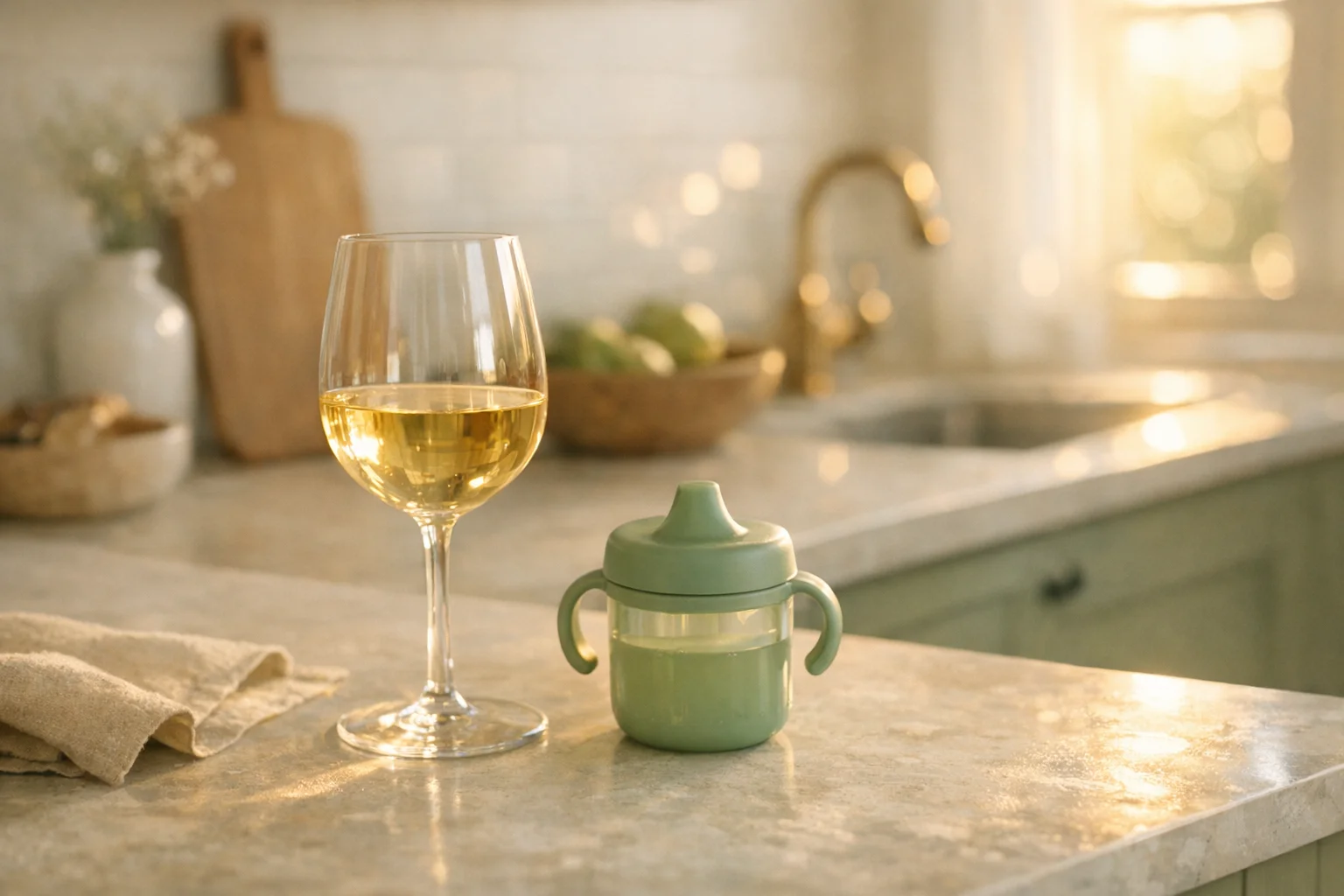
What this looks like in real life: a glass and a half of wine after the kids are in bed, five or six nights a week. Not a binge. A consistent, pour-and-a-half rhythm that does not feel dramatic from the inside but accumulates a specific weekly load.
NIAAA defines heavy drinking for women as more than three drinks on any single day or more than seven drinks across a week. A glass and a half of wine, six nights a week, lands at about nine drinks weekly. That is over the line, not under it. Most mothers I know who pour a nightly glass are surprised to find the math comes out where it does.
Why a Nightly Drink Is Mechanically Different from a Weekend Drink
This is where the picture stops being about culture and starts being about biology. The same 5-ounce pour does different things to a brain depending on whether it is the first one this week or the two-hundredth in a row.
Alcohol works on the brain primarily by binding to GABA-A receptors, the brain's main inhibitory channel. Acute exposure boosts inhibitory signaling, which is the calming effect you feel ten or twenty minutes after the first sip. Kumar and colleagues' 2009 review of GABA-A receptor plasticity in Psychopharmacology showed that chronic exposure, the kind that comes from a glass every night for months, changes the receptors themselves. Specific subunits get internalized. The configuration of the receptor on the cell surface adapts. The result is tolerance. The same dose does less.
What the brain has not done is gotten rid of its excitatory side. So when you go even a few hours without a drink, the inhibitory side is now under-functioning while the excitatory side keeps firing. Becker 2014, a Handbook of Clinical Neurology chapter on the neurochemistry of alcohol withdrawal, describes this as a hyperglutamatergic state. The brain runs hot. This is the mechanism behind the 3 AM wake-up, the next-day baseline anxiety, and the Sunday-night dread that mothers who drink most nights describe almost identically.
A weekend drinker's brain resets between Sunday and Friday. The receptors return toward baseline. A nightly drinker never lets that reset happen. Each evening's pour is being applied to a brain that has been adapting in one direction for weeks or months. The buzz fades faster. The morning gets a little more frayed. The pour gets a little bigger.
This is biology, not character. It is also the answer to the question I was actually asking when I asked "is this still normal." Whether or not it was normal, it was doing more to my nervous system than I had been told.
Spectrum, Not Verdict: The Better Question to Ask
Most of the search results that show up for "is it normal for moms to drink every night" are written through a recovery-industry lens. They list "warning signs," frame the answer as "are you crossing into a disorder," and assume the person reading is a worried adult child looking up information about a parent. None of that frame fits the mom standing in her own kitchen at 5:48 PM.
The relevant clinical reality has a cleaner current frame. In 2013, the DSM-5 workgroup, led by Hasin and colleagues in the American Journal of Psychiatry, collapsed the older binary of alcohol abuse and dependence into a single condition with severity dimensions. Two to three symptoms is mild. Four to five is moderate. Six or more is severe. The whole condition exists on a continuum.
Two years later, Grant and colleagues' NESARC-III analysis, published in JAMA Psychiatry, applied those criteria to a national sample of 36,000 US adults. The 12-month prevalence of any-severity alcohol use disorder was 13.9 percent. Lifetime prevalence was 29.1 percent. Most adults meeting criteria sat at the mild or moderate end, not the severe one.
If you take those numbers seriously, the binary "yes-or-no labeling" does the worst kind of bookkeeping. It misses about nine out of ten people whose drinking is actually doing something to their lives. It is the wrong question.
The better question is the one I started asking myself at the kitchen island in March 2024. Not "have I crossed a line." Not "do I qualify for a label." But: is this drinking giving me what I want, and what is it costing me to keep it where it is? That question gets answered with attention, not a quiz. The longer mom-voice spectrum map I wrote on grey area drinking sits underneath this post for the reader who wants the full picture of where this kind of drinking actually lives clinically.
Questions Worth Sitting With, Not a Checklist
These are not a quiz. They are a quieter ten minutes with yourself.
- If a close friend asked, with no judgment in her voice, how many nights a week you actually drink, would your honest answer match what you have been telling yourself?
- When you imagine three Tuesday nights in a row without a drink, what is the feeling that comes up first?
- Is the first pour ever earlier than you intended? Has 5:30 PM turned into 5:00 turned into 4:50?
- Are there things you used to do in the evening (call your sister, walk the dog, read a real book) that have quietly shifted to after the second pour, or stopped happening?
- What does the morning after a no-drink night feel like in your body, compared to the morning after a one-glass night?
- Are you spending mental energy managing the drinking (counting, timing, the bottle in the recycling) that you did not used to spend?
- Has the amount required to feel the same calm gone up over the last year?
If several of those made you pause, you are paying attention. That is the only diagnostic posture I trust on this question.
Where the Nightly Glass Came From
Two stories run in parallel here, and both are true.
The cultural story is documented. Wine companies have spent twenty years building marketing infrastructure aimed specifically at mothers: gift sets sold next to the kids' aisle, wine-themed mom-meme accounts that quietly partner with brands, group-chat shorthand that turned the 5 PM glass into a self-care symbol. The 6 PM witching hour I wrote up in a separate post is the exact slot the entire wine-mom marketing complex has built itself around.
The biological story is quieter. Mothering is a sustained cortisol load. Caregiving is sleep-fragmented by definition. The reward system of a tired mother is genuinely under-resourced by the end of the day, and alcohol is a fast, predictable, legal way to deliver a small inhibitory boost to a brain that has been ramping up since 6:30 AM. That mechanism is also why the alcohol-anxiety cycle hits mothers especially hard. The chemistry that makes 5:48 PM feel earned is the same chemistry that has the 3 AM wake-up waiting on the other side.
Neither story is the whole answer. Both being true at the same time is what makes this so hard to see clearly from inside a Tuesday.
If You Decide You Want to Change Something
You do not have to decide whether you have crossed any line. You can just decide whether you want this nightly thing to keep being part of your life as it currently is, or whether you want to test what happens if it shifts.
Three small moves that worked for me, in roughly the order they helped:
- Count for one ordinary week. Pour into a measured 5-ounce glass and write it down. Do not interpret. The gap between what you think the count is and what it actually is, is the information.
- Move the first pour later by 45 minutes. Not stop. Move. Putting the pour at 6:33 PM instead of 5:48 PM separates the cue from the response and lets you watch what your body does in the gap.
- Pick one weeknight, the same one each week, and do not drink. Tuesday is a good one because it has no social pressure attached. Notice what shifts on Wednesday morning, in your sleep and your mood.
Around the time I was on week three of doing those, I tried the Reframe app. I had been searching the question this post is named after for two years before that, and what the daily neuroscience lessons did was turn a vague worry into specific things I could test in my own evening. It is one option among several. SMART Recovery offers free CBT-based meetings online. Annie Grace's Alcohol Experiment is a free 30-day structured program. Individual therapy with a qualified clinician is always a legitimate door. I weigh each against the others in a separate post.
What I want to leave you with is the sentence I wish someone had handed me at 5:48 PM in March 2024. The question was never whether I had crossed a line. The question was whether my nightly habit was making my actual life better or quieter or smaller, and whether I was willing to look at the answer honestly. I write The Clear Mom because the answer changed slowly, in small specific moves, and I would have wanted a mom-voice version of all of this from someone who had already walked through the kitchen on the other side.
This post is written from personal experience and cites peer-reviewed research. It is not medical advice. If you're concerned about your drinking or your health, please speak with a qualified clinician.