Mom burnout and drinking form a bidirectional loop. Alcohol's GABAergic sedation feels like rest, but it triggers a glutamate rebound and an HPA-axis cortisol spike that fragment the second half of sleep and deepen the next day's exhaustion, which then gets re-medicated. The way out is recognizing the difference between cope-as-rest, which sensorially mimics restoration but blocks it, and real rest, then removing the substance that keeps the loop running.
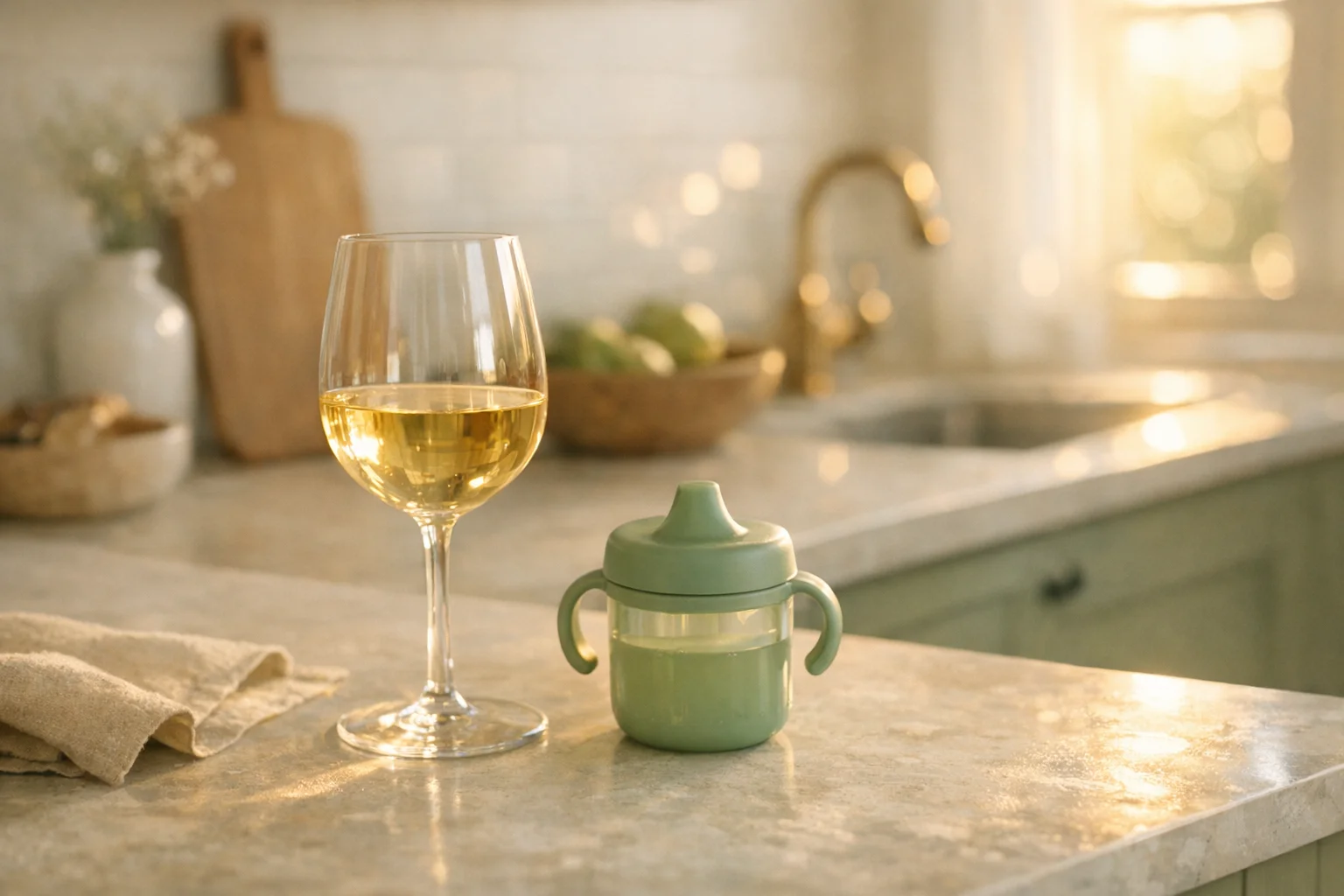
By 5:48 PM on a Thursday in March 2024, the cabernet was in my hand and I would have told you, if you had asked, that I was finally getting a moment to rest. The pour was warm. The signal arrived in my body within ten minutes. The day's third caregiving sprint was over.
This is what mom burnout and drinking look like in real time, when you are inside them. It does not feel like a crisis. It feels like a small mercy. By morning, I would wake at 6:30 with the day's edge already sharper than it had any right to be.
This post is the version I wish I could hand my younger self. It is the loop, named and sourced, and why I started writing The Clear Mom.
What Mom Burnout and Drinking Actually Look Like
The phrase "mom burnout" gets used in mom-text threads as shorthand for tired. The construct is older and more specific. The foundational Maslach, Schaufeli, and Leiter (2001) paper "Job Burnout," in Annual Review of Psychology, defines burnout as a three-dimensional response to chronic situational demands: emotional exhaustion, cynicism or depersonalization, and reduced personal accomplishment. The model was built for occupational settings, but the construct maps cleanly onto a mother's day.
Emotional exhaustion is the easiest to recognize. The well is dry by 4 PM. Reading one more page of the bedtime book costs more than it should. Depersonalization shows up softer than the term sounds: a flatness, a mechanical tone, an internal eye-roll at the same toddler question for the eleventh time. Reduced personal accomplishment is the quiet sense that whatever you did all day did not move anything that mattered.
Each dimension has a chemistry the nightly pour interacts with. Exhaustion is a physiological state of sleep debt, cortisol load, and dopamine downregulation. Cynicism has a stress-response signature. Reduced accomplishment is partly a memory and motivation phenomenon. Wine touches all three on the same evening, which is why it feels like it helps, and is also why, on a longer timescale, it makes each one worse.
How Alcohol Hooks Into the Burnout Loop
Nothing on the first page of search results for mom burnout and drinking actually names the mechanism. They tell you alcohol is a coping tool. They do not tell you it is a coping tool that deepens the thing it appears to relieve. The loop has four steps and they run on a clock.
Step one. Alcohol binds to GABA-A receptors, the brain's primary inhibitory channel. Kumar and colleagues (2009), in Psychopharmacology's decade review of GABA-A receptor research, detail how this delivers acute sedation. This is the warmth, the slowdown, the felt rest, arriving within ten to twenty minutes. Cope-as-rest, in its first crossing.
Step two. Across the next four to six hours, alcohol clears and the brain compensates. Becker (2014), in Handbook of Clinical Neurology, describes the rebound as hyperglutamatergic. The excitatory side, suppressed during sedation, returns hot.
Step three. The HPA stress axis activates. Stephens and Wand (2012), in Alcohol Research: Current Reviews, document that alcohol elevates cortisol and engages the stress system in a way that persists past the felt buzz. The cortisol architecture you wake up into is not the one you would have woken up into without the drink.
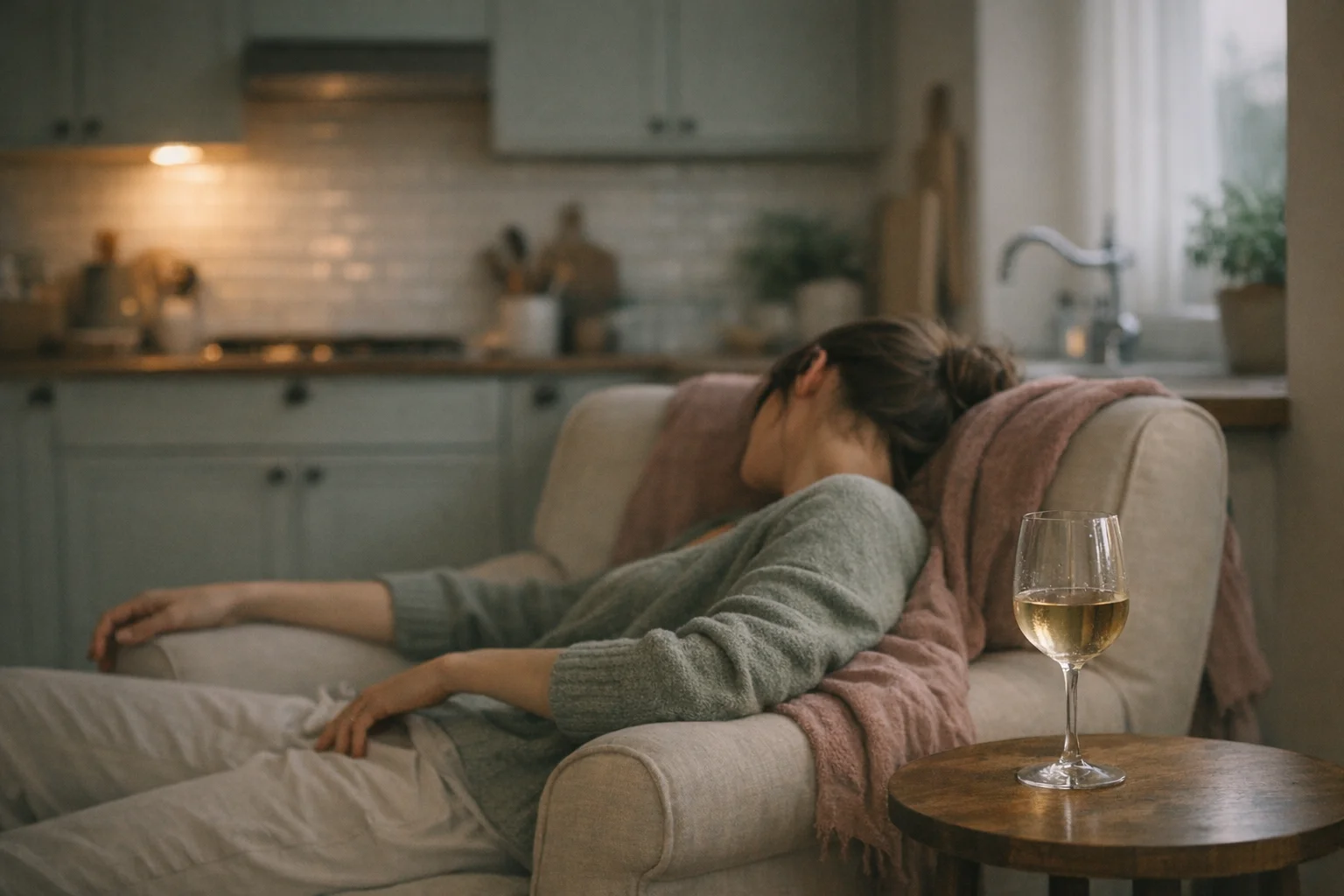
Step four. Sleep fragments. Ebrahim and colleagues (2013), in a systematic review in Alcoholism: Clinical and Experimental Research, found alcohol reduces REM and increases nocturnal awakenings as it clears. The 3 AM wake-up is not a coincidence. It is the rebound and the cortisol arriving on schedule.
The next day starts with measurably less rest than last night promised. That deficit is what the day's caregiving load is now pressed against. By 5:48 PM, the cope-as-rest signal is doing more work than it did the night before. The loop tightens.
What the Research Says About Working Mothers and Alcohol
The most useful single paper on this question is a 2025 systematic review titled "Dissolving contradictory demands: A systematic review of alcohol use of working mothers," by Patsouras, Wright, Caluzzi, and colleagues, in Drug and Alcohol Dependence. The review synthesized 22 studies of working mothers in high-income countries.
Two findings stand out. Working mothers were more often drinkers and consumed higher quantities per occasion than comparison groups of midlife women. The pattern was not a binge pattern; it was a steady, occasion-elevated rhythm that fits the nightly-pour shape precisely. Across the studies, alcohol functioned as a coping mechanism for the gendered combination of work and caregiving expectations. The authors framed it as a way of dissolving contradictory demands. Read that twice.
Michael Frone's 2008 Journal of Applied Psychology analysis of how work stressors relate to alcohol use over time found that work overload and job insecurity were associated with alcohol use before, during, and after the workday once temporal context was measured. The tension-reduction pathway shows up clearly. Frone's sample was working adults, not mothers specifically, but the mechanism is the same one operating in the maternal-load case.
Building on Cooper's foundational motivational model (1994, in Psychological Assessment), drinking motives sort into four categories: coping, enhancement, social, and conformity. Coping motives are most consistently linked to drinking problems. The mom-pour at 5:48 PM, after a sustained-cortisol day, sits squarely in the coping lane.
The longer write-up sits at the science of how alcohol accelerates the burnout curve. None of these papers were written specifically about cope-as-rest. They describe the substrate. The framing is what happens when you stack them.
Cope-as-Rest vs. Real Rest: The Framework I Wish I'd Had
This is the named distinction. Use it as a tool, not a slogan.
Cope-as-rest is anything that produces the sensory signature of rest, the warmth and threshold-crossing and slowdown, while doing chemical work that prevents the body from coding the experience as restorative. A glass of wine is the cleanest example. So is doom-scrolling with the brain in low-grade alarm. So is fast food eaten standing up because that finally is sitting down with no one asking for anything.
Real rest is anything the body registers as restoration. Slow-wave sleep that is not chemically truncated. A flat-on-back twenty-minute pause with eyes closed. A walk outside, alone, slow enough that the heart rate drops. A long shower with the lights low. The criterion is parasympathetic activation, not the felt vibe of finally sitting down.
The diagnostic question for any evening behavior is the morning question. Did the body wake up restored, or with the load slightly larger? Cope-as-rest fails the morning test reliably. Real rest, by definition, does not.
The hardest part of the framework is what it implies about the wine glass. The reason it feels restful is the same reason it cannot be. The warmth at 5:48 PM and the actual restoration the body needs are produced by the same molecule on opposite halves of its action curve.
What I Tracked for 30 Days
In March 2024 I ran a structured month-on, month-off comparison and wrote it down. I am not a researcher; I am a mother with an Oura Ring, a notes app, and the question "is this thing actually doing what I think it is."
Month one was business as usual. A 5-ounce pour of cabernet most weeknights between 5:45 and 6:30 PM, sometimes a second glass after the kids were down, two glasses on Saturday. I tracked drinks per evening, fatigue at 7 AM on a one-to-ten scale, and Oura's sleep score and HRV.
Average evening drinks: 1.4. Average morning fatigue: 6.8. Sleep score: 71. HRV: 28 ms. These are my numbers; the point is the deltas, not the absolutes. They sit close to the population pattern the every-night pattern that hides inside this loop documents.
Month two: alcohol-free, same bedtime, everything else held constant. The first four nights were worse on the felt-rest measure. Sleep latency stretched. By night seven the second half of sleep started consolidating. By the end of week two, morning fatigue dropped to 4.4, sleep score climbed to 81, and HRV moved to 41 ms.
The numbers are not the headline. The headline is what they describe. Month one's cope-as-rest had been costing me about two and a half points of morning fatigue, ten points of sleep score, and thirteen milliseconds of HRV every single morning. The wine was not adding rest to my evenings. It was borrowing rest from my mornings and not paying it back.
Practical Ways to Step Out of the Loop
Not a listicle of ten things to do instead of wine. Three reframings that change the shape of the loop, in roughly the order they helped.
First, name the cope-as-rest moment when it arrives. The 5:48 PM threshold-crossing, the day-is-over signal the body is genuinely asking for. The signal is real. The wine is one delivery vehicle for it among many. A hot shower, ten minutes of nothing on the back deck, a stretch on the floor with the lights low, a mug of decaf tea, an early-evening walk. The 6 PM cope pattern I had to redesign first walks through twelve of these in detail. They are not consolation prizes. They are different deliveries of the same threshold-crossing your body wants.
Second, protect the second half of sleep deliberately. This is the half the loop has been quietly stealing. A consistent bedtime, no screens past a chosen hour, a cooler bedroom, and no liquid past 9 PM if you are over forty. Whatever combination of inputs lets the second half of the night run uninterrupted, treat as load-bearing infrastructure, not optional self-care.
Third, around week three of any meaningful change, structured tools start to matter more than they did in week one. I started using the Reframe app then. The daily lessons fit between dish-loading and the next thing, short and dense and grounded in neurobiology, and what they did was reframe the cope-as-rest illusion specifically. The sedation was real. The rest was not. The categorical content on sleep, stress response, and reward circuitry put a shape under what the loop had been doing for years. It is one option among several. SMART Recovery, Annie Grace's Alcohol Experiment, and individual therapy with a qualified clinician are alternatives worth knowing about. I lay them out side by side elsewhere.
When Mom Burnout and Drinking Need More Than a Mindset Shift
There is a point where the loop is tighter than a post like this one can address. None of what follows is a verdict. It is a list of signals worth bringing to a clinician.
If you have tried to cut back several times and the pattern returns within weeks. If morning fatigue, baseline anxiety, or low mood have not lifted after a real break from drinking. If you are managing more drinking than you have told anyone. If alcohol is being used to manage a known anxiety or trauma history. If burnout is not lifting even when situational load lifts.
Hasin and colleagues (2013), introducing the DSM-5 alcohol use disorder criteria in the American Journal of Psychiatry, framed the population picture: the condition exists on a continuum from mild to severe, and most adults meeting any-severity criteria sit at the mild or moderate end. A conversation with a primary care clinician, a therapist, or both is more useful than any quiz on the internet. Earlier conversations are easier than later ones.
If something here is sitting heavily, that is information, not a diagnosis. Bring it to someone whose job is to listen and prescribe carefully.
What I want to leave you with is the version I wish I had read at 5:48 PM in March 2024. The rest you cannot find at the bottom of a glass is not because you have not tried hard enough. It is because the molecule the glass delivers does the opposite of what your body needs. Cope-as-rest is real coping. It is not real rest. The loop steps out the moment the two stop being the same word.
This post is written from personal experience and cites peer-reviewed research. It is not medical advice. If you're concerned about your drinking or your health, please speak with a qualified clinician.