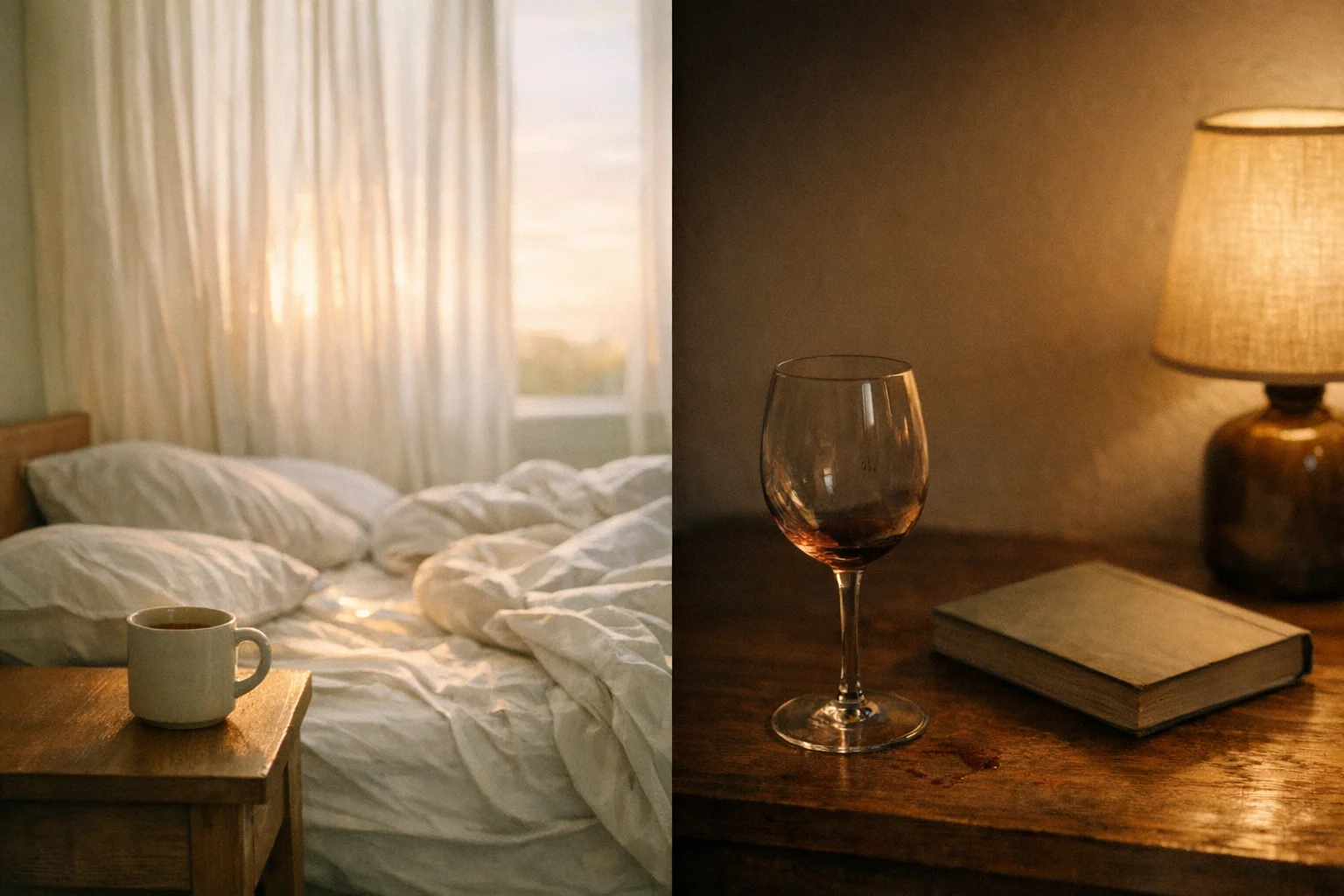
Yes, through two stacking mechanisms. First, alcohol dilates your blood vessels within about ten minutes, sending heat from your core to your skin. Second, perimenopause has already narrowed the temperature zone in which your body stays comfortable, so alcohol's vasodilation lands in a thermostat that was set to overreact, and an hour or two later your body overcorrects by cooling too aggressively, which is why the soaked-sheets 3am wake-up so often follows a second glass of wine, especially red.
It's 11:07 PM on a Tuesday and you're standing at the bathroom sink, pressing a cold washcloth against your neck. Your shirt is damp. Your chest is pink. You had one glass of wine at dinner, maybe a splash from the second while you were cooking, and now your body is behaving like you're in a sauna. You look in the mirror and ask the question every perimenopausal mother has asked at this exact hour: was that the wine, or is this just what 42 feels like?
I spent most of 2024 asking a version of that question in my own bathroom. The answer, once I actually read the research, is both. Perimenopause rewires your thermostat. Alcohol hijacks a thermostat that is already rewired. The two effects do not just add; they multiply. This post walks through what is actually happening hour by hour, and what the peer-reviewed evidence says about whether that second glass is the reason you wake up soaked at 3am.
For the wider context on why your body responds to alcohol so differently in your late 30s and 40s, I wrote about the full biology of the perimenopause factor in an earlier piece on The Clear Mom. This post zooms in on the specific hot-flash mechanism.
What a Hot Flash Actually Is: The Thermoneutral Zone
To understand why alcohol amplifies hot flashes in perimenopause, you first have to understand what a hot flash actually is. It is not your body getting hotter. It is your body behaving as though it is too hot, even when your core temperature has barely moved.
Freedman (2014), writing in the Journal of Steroid Biochemistry and Molecular Biology, describes hot flashes as an exaggerated heat-dissipation response driven by a narrowed thermoneutral zone. Your hypothalamus, the part of your brain that regulates body temperature, maintains a range of core temperatures within which no corrective action is needed. Outside that zone, you sweat to cool down or shiver to warm up.
In a premenopausal body, that zone is relatively wide. Core temperature can drift by several tenths of a degree with no response. In perimenopause, the zone narrows. In some women it collapses almost to a single point, which is why a warm room, a hot meal, or a glass of wine can tip you into full heat-dissipation mode (vasodilation, sweating, flushing) even though your actual core temperature barely moved.
A hot flash, in other words, is a normal thermoregulatory response to a tiny trigger in a body whose thermostat is set to overreact. That framing matters because it tells you what actually drives the flash: not heat itself, but the combination of a narrowed zone plus any small nudge upward.
Why Perimenopause Narrows Your Thermostat
The thermoneutral zone narrows in perimenopause because estrogen influences the hypothalamus directly. When estrogen is stable, the thermostat keeps the zone wide. When estrogen begins to fluctuate and decline, the zone collapses.
Freedman (2014) notes that this narrowing is accompanied by elevated sympathetic activation, the fight-or-flight branch of the nervous system. Your body runs slightly hotter at baseline, slightly more vigilant, always a little closer to its heat-dissipation threshold. A small push that used to be absorbed silently now triggers the full cascade: skin vasodilation, chest flushing, sweat across the back of your neck, sometimes a chill on the other side as your body overcorrects.
Shihab and colleagues (2024), in a narrative review in Maturitas, documented that this thermoregulatory fragility is a defining feature of midlife hormonal transition, and that alcohol during this window intensifies both vasomotor symptoms and the sleep disruption around them. So your thermostat is hypersensitive. Anything that nudges your core temperature up is now more likely to trigger a full flash. And alcohol does exactly that, through a mechanism that has nothing to do with estrogen at all.
Does Alcohol Make Hot Flashes Worse? The Vasodilation Mechanism
Yoda and colleagues (2005), in a controlled human study in Alcohol, gave healthy adults a dose of alcohol and measured thermoregulation minute by minute. Within ten minutes of ingestion, skin blood flow and chest sweating increased significantly. Within twenty minutes, deep body temperature began to drop. By the thirty-minute mark, core temperature had fallen roughly 0.3 degrees Celsius below baseline, because the body was shedding heat through vasodilation and sweat faster than it could produce it.
Translation: alcohol opens your blood vessels, pushes blood to the skin, makes you sweat, and drops your core temperature. This is the same response your body produces when you are trying to cool down in a hot room. Alcohol triggers it whether or not you actually need to cool down.
Now stack that on a perimenopausal thermostat. Your thermoneutral zone is already narrow. Your sympathetic nervous system is already slightly activated. Any small trigger would already tip you into a flash. Alcohol then dumps heat to your skin in a way that a premenopausal body would shrug off but a perimenopausal body reads as a full thermal event.
That is the first mechanism. It is fast, it is physical, and it happens every time you drink. The second mechanism kicks in later, and it is the reason so many of the worst flashes are the 3am soaked-sheets kind.
Hour by Hour: What a Glass of Wine Does to a Perimenopausal Body
Here is how a single evening plays out when you have a glass of wine with dinner and another with cleanup, last sip around 8:30 PM, lights out at 10:30. Each time stamp is anchored in the research.
8:30 PM, Hour 0: last sip. Blood alcohol near peak.
8:40 PM, Hour 0:10: vasodilation begins. Skin blood flow rises and chest sweating starts within ten minutes (Yoda et al., 2005). In a perimenopausal body with a narrowed thermoneutral zone, that warm rush lands as a full flash. You take off a layer.
9:00 PM, Hour 0:30: thermoregulatory overshoot. Your body is shedding heat faster than producing it. Core temperature drops roughly 0.3 degrees Celsius below baseline. A chill may settle in after the flush passes.
10:30 PM, Hour 2: lights out. Alcohol drops you into deep sleep fast. Ebrahim and colleagues (2013), in Alcoholism: Clinical and Experimental Research, documented that alcohol shortens sleep onset at all doses and increases slow-wave sleep in the first half of the night.
1:00 AM, Hour 4:30: blood alcohol falling fast. Your liver has processed most of the two drinks. The sedative effect is fading. The compensatory brain changes your brain made earlier are no longer being masked.
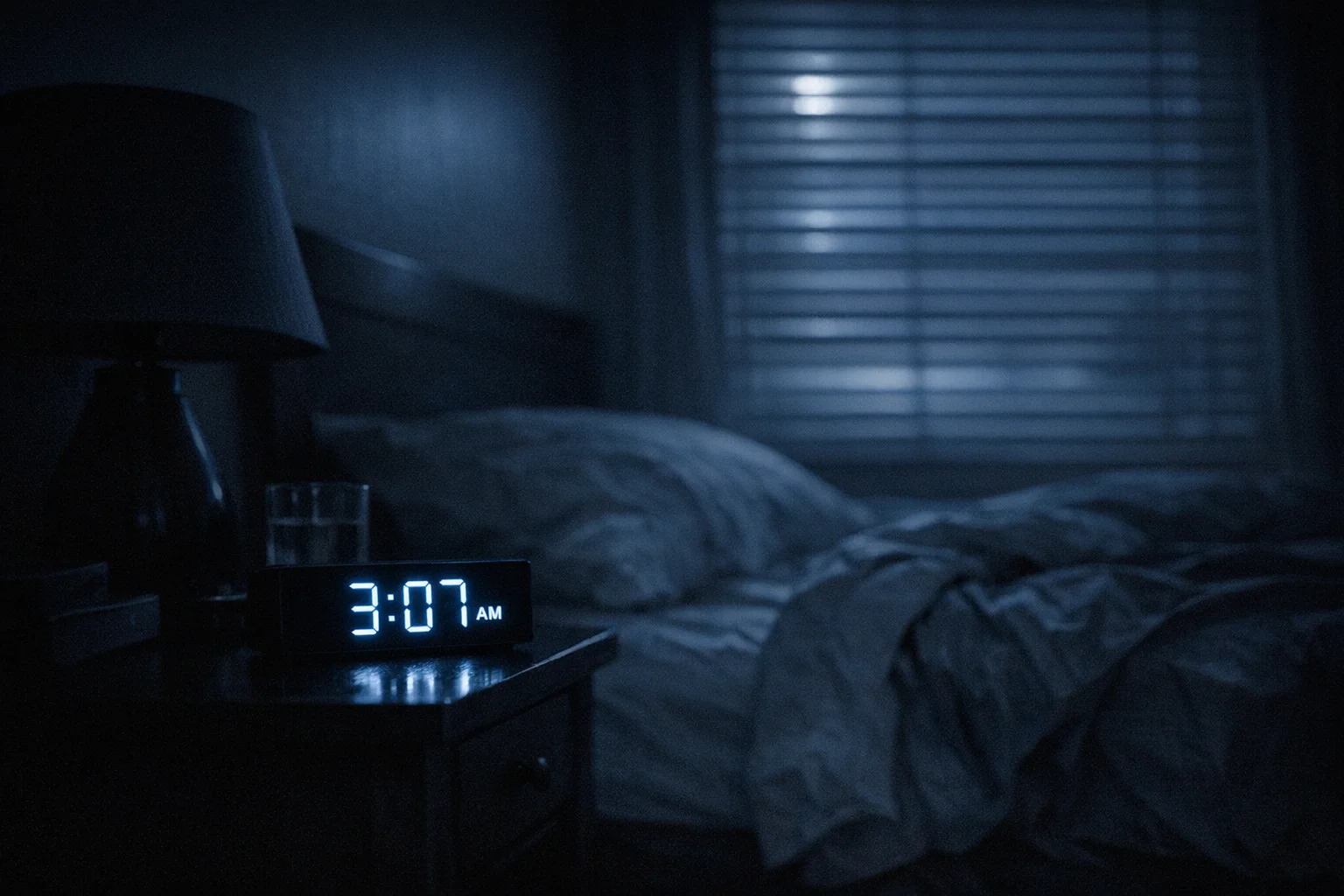
2:30 to 3:30 AM, Hours 6 to 7: the convergence. Two things happen at once. Glutamate rebound: Becker and Mulholland (2014) describe how NMDA receptors suppressed earlier are now unmasked and flooded with excitatory signaling. Cortisol spike: Blaine and colleagues (2016) found that falling blood alcohol triggers HPA axis activation, lifting cortisol and norepinephrine hours earlier than your natural circadian rise. Your sympathetic nervous system lights up. Your body runs warm again. The thermoneutral zone, still narrowed, registers this as another thermal event. You wake up soaked, heart racing, unable to cool down. For a deeper look at why 3am specifically, see why you always wake up at 3am after drinking.
Why Wine Seems Worse Than Other Alcohols
If red wine triggers flashes more than vodka or beer at what feels like equivalent amounts, you are not imagining it. Ethanol is not the only variable.
Esposito and colleagues (2019), in Molecules, analyzed the biogenic amine content of red and white wines and found that reds contained substantially more histamine: median levels around 7.3 mg/L in reds versus 2.5 mg/L in whites. The difference comes from malolactic fermentation, which is standard for most reds and rare for whites.
Histamine is a potent vasodilator. It is the same molecule your immune system releases during an allergic reaction. When you drink red wine, you are absorbing ethanol and getting a direct histamine dose on top. Red wine also contains tyramine and sulfites, which add vasoactive load. For women with lower diamine oxidase activity (the enzyme that clears histamine), the effect compounds, which is why some women flush immediately after a single sip of red while others barely notice.
There is a second reason wine hits harder in a home setting. American home pours often land at 7 to 10 ounces, not the standard 5. Two "glasses" can quietly deliver the ethanol of three or four standard drinks, which pushes peak blood alcohol higher and stretches thermoregulatory disruption further into the night. Wine is also the drink most embedded in evening rituals for mothers, which means the 8 PM pour and the 2:30 AM wake-up arrive together, night after night, in a near-identical pattern.
What My Month On, Month Off Tracker Actually Showed
The research was clarifying, but what finally changed my behavior was keeping my own data.
For the month of February 2024, I drank 3 to 4 nights a week, usually one glass of wine with dinner, occasionally two. I tracked two things in a notebook: the daytime hot flashes I counted, and whether I woke up sweating at night. For the month of March, I drank zero. Same notebook, same tracker.
The pattern was unmistakable. Nights that followed a drinking evening produced a soaked-sheets wake-up roughly two-thirds of the time. Alcohol-free evenings produced one about once a week, usually after a stressful day. Daytime flashes were less affected by alcohol than by the previous night's sleep quality, which itself was downstream of the drinking from the night before that.
The mixed research matches what I saw. Schilling and colleagues (2007), in Fertility and Sterility, found that current alcohol use was associated with slightly lower daytime hot-flash risk in some perimenopausal women, possibly via blood glucose effects. But Kwon and colleagues (2022), in Nutrients, found a dose-dependent positive association between alcohol consumption and moderate-to-severe vasomotor symptoms, with the strongest signal on night sweats. The nighttime version is where the effect lives. My tracker agreed.
Thurston and Joffe's 2011 SWAN review established that women with moderate-to-severe hot flashes are nearly three times more likely to experience frequent nocturnal awakenings. Layer alcohol on top of that baseline and you get the full chain: vasodilation, overshoot, rebound cortisol, amplified flash, broken sleep, next-day anxiety. For the full map of that loop, I wrote about it in our pillar on alcohol, anxiety, and sleep.
If You're Not Ready to Quit: The Harm Reduction Version
Stopping drinking is the most reliable way to reduce alcohol-related hot flashes, because every mechanism in this post starts with ethanol. No ethanol, no vasodilation, no overshoot, no cortisol spike, no rebound flash at 3am.
If you are not there yet, here is what the evidence supports as harm reduction.
Drink earlier. Pushing your last sip to 5 or 6 PM lets the vasodilation and sweating phase complete before your sleep window, which cuts the night-sweat wake-up most reliably.
One drink, not two. The thermoregulatory response is dose-dependent. A single drink produces a smaller core-temperature drop and a shorter rebound.
Choose lower-histamine drinks. If red wine consistently triggers flashes, a cleaner option (white wine, vodka with soda) removes the histamine layer while still delivering the ethanol you were after. The ethanol still causes vasodilation; the histamine is an extra hit you can cut.
Eat with your drink. Food slows absorption, lowers peak blood alcohol, and softens both the peak and the rebound.
Pre-cool your bedroom. A room at 65 to 67 degrees Fahrenheit gives a narrowed thermoneutral zone more margin. Cotton pajamas and a separate top sheet help you adjust without waking your partner.
Hydrate before bed. Alcohol is a diuretic, and dehydration amplifies nighttime sympathetic activation.
None of these change the biology of perimenopause. They only reduce the alcohol-specific layer. If you want a set of ideas for the 6 PM wind-down slot that do not involve alcohol at all, I pulled together twelve things that actually help more than wine.
When I was applying all of this to my own evenings, the daily lessons in the Reframe app gave me language for what was happening in my body between dinner and midnight. A lesson on body-heat and vasomotor triggers happened to land the same week I was tracking flashes, and lining up what the lesson described with my own tracker data was the first time I could see the correlation clearly. Your mileage may vary, but it was the tool that helped me connect the research to what I was actually logging.
This post is written from personal experience and cites peer-reviewed research. It is not medical advice. If you're concerned about your drinking or your health, please speak with a qualified clinician.