The 6 PM wine craving isn't about the wine — it's about what the wine represents: a transition, a reset, a boundary between "on" and "off." Here are 12 evidence-backed alternatives that address the actual neurological need behind the craving, from vagus nerve activation to dopamine-boosting movement to L-theanine-rich tea rituals. Each one takes less than 10 minutes, costs next to nothing, and works with your brain instead of against it.
I used to think 6 PM wine was about relaxation. After two years of research and twelve months of experimentation — including my own reckoning with the daily pickup routine — I know it's about something more specific: the need for a transition. From work mode to home mode. From "managing everything" to "I'm allowed to stop managing for a minute." From overstimulated to something calmer.
Wine worked for that — temporarily. But the neuroscience of the anxiety-drinking cycle shows that the relaxation is borrowed. Alcohol suppresses your stress response for about 90 minutes, then creates a rebound effect that leaves you more anxious, more depleted, and less able to handle the rest of the evening.
These 12 alternatives address the real need behind the craving. I've tested all of them. Some will work for you; others won't. The goal is to find two or three that reliably get you past the 15-20 minute craving window — because that's how long it takes for the urge to peak and subside.
Why 6 PM Is the Hardest Time of Day
Before the list, it helps to understand why this specific time of day is so difficult. Three things converge between 5 and 7 PM:
Cortisol peaks. Your body's primary stress hormone follows a circadian pattern, and late afternoon brings a natural cortisol spike (Weitzman et al., Journal of Clinical Endocrinology & Metabolism, 1971). You're not imagining the tension — it's hormonal.
Decision fatigue sets in. Research by Baumeister and colleagues (published in the Journal of Personality and Social Psychology, 1998) demonstrated that willpower and decision-making draw from a limited daily resource. By 6 PM, after a full day of parenting decisions, work decisions, and household management, your prefrontal cortex is running on fumes. This is precisely when habits take over — because habits bypass the decision-making process entirely.
Environmental cues trigger the habit loop. The sound of your kids coming through the door. The sight of the kitchen. The feeling of the day closing in. If you've repeatedly paired these cues with wine, your brain's dopamine system starts firing before you've even made a conscious decision. Neuroscientist Wolfram Schultz's research on reward prediction shows that dopamine spikes in anticipation of a reward, not just in response to it (Schultz, Neuron, 2016). The craving you feel at 6 PM is your brain predicting the reward it's learned to expect.
Understanding this is power. Because once you know the craving is about cortisol, fatigue, and prediction — not about needing alcohol — you can address each piece directly.
The 12 Alternatives (and Why Each One Works)
1. Cold Water on Your Wrists or Face
What to do: Run cold water over your inner wrists for 30 seconds, or splash cold water on your face. In the summer, keep a damp washcloth in the freezer and press it to your face and neck.
Why it works: Cold water activates the mammalian dive reflex — an involuntary physiological response that lowers your heart rate and redirects blood flow to your core organs. Research published in Frontiers in Physiology (Kinoshita et al., 2006) found that facial immersion in cold water triggers parasympathetic nervous system activation within seconds, reducing the fight-or-flight state that drives the craving. It's the fastest nervous system reset on this list.
Amy's note: This one felt ridiculous the first time I tried it. But it works almost instantly. I now keep a bowl of ice water on the counter during the witching hour. My kids think I'm weird. I think I'm regulated.
2. Five-Minute Walk Outside
What to do: Walk out your front door and go around the block. That's it. Five minutes. You can bring kids, or tell them you'll be right back.
Why it works: A study published in the International Journal of Environmental Research and Public Health (Meredith et al., 2020) found that just five minutes of outdoor walking significantly reduces cortisol levels. The combination of movement, natural light exposure (which influences serotonin production), and environmental change disrupts the cue-craving-reward loop by physically removing you from the context where the habit lives. Your kitchen is the cue. The sidewalk isn't.
Amy's note: This became my single most reliable tool. Something about crossing the threshold of the front door resets my nervous system in a way nothing inside the house can replicate.
3. Box Breathing (or 4-7-8 Breathing)
What to do: Inhale for 4 counts, hold for 4 counts, exhale for 4 counts, hold for 4 counts. Repeat 4 times. Alternatively, try 4-7-8 breathing: inhale for 4 counts, hold for 7, exhale slowly for 8.
Why it works: Controlled breathing activates the vagus nerve, which directly stimulates the parasympathetic nervous system — your body's "rest and digest" mode. Research by Gerritsen and Band (Frontiers in Human Neuroscience, 2018) demonstrated that slow, controlled breathing reduces cortisol, lowers heart rate, and shifts brain activity toward calmer states within 90 seconds. The extended exhale is key — a longer out-breath than in-breath signals safety to your nervous system.
Amy's note: I do this in the car in the school pickup line. By the time the kids get in, I've already completed my transition. No wine required.
4. Something Crunchy, Sour, or Spicy
What to do: Eat something with an intense flavor or texture: a sour pickle, salted almonds, a few slices of ginger, hot sauce on crackers, or sour candy.
Why it works: Strong sensory input interrupts the craving circuit by redirecting your brain's attention. This is a technique borrowed from dialectical behavior therapy (DBT), specifically the TIPP skills developed by Marsha Linehan. Intense sensory experiences — especially sour or cold — activate different neural pathways and can break the fixation on a specific craving. Think of it as giving your brain something loud enough to listen to instead of the wine signal.
Amy's note: Sour pickles became my 6 PM snack. Weird? Yes. Effective? Absolutely. My kids now associate the pickle jar opening with "Mom's decompressing."
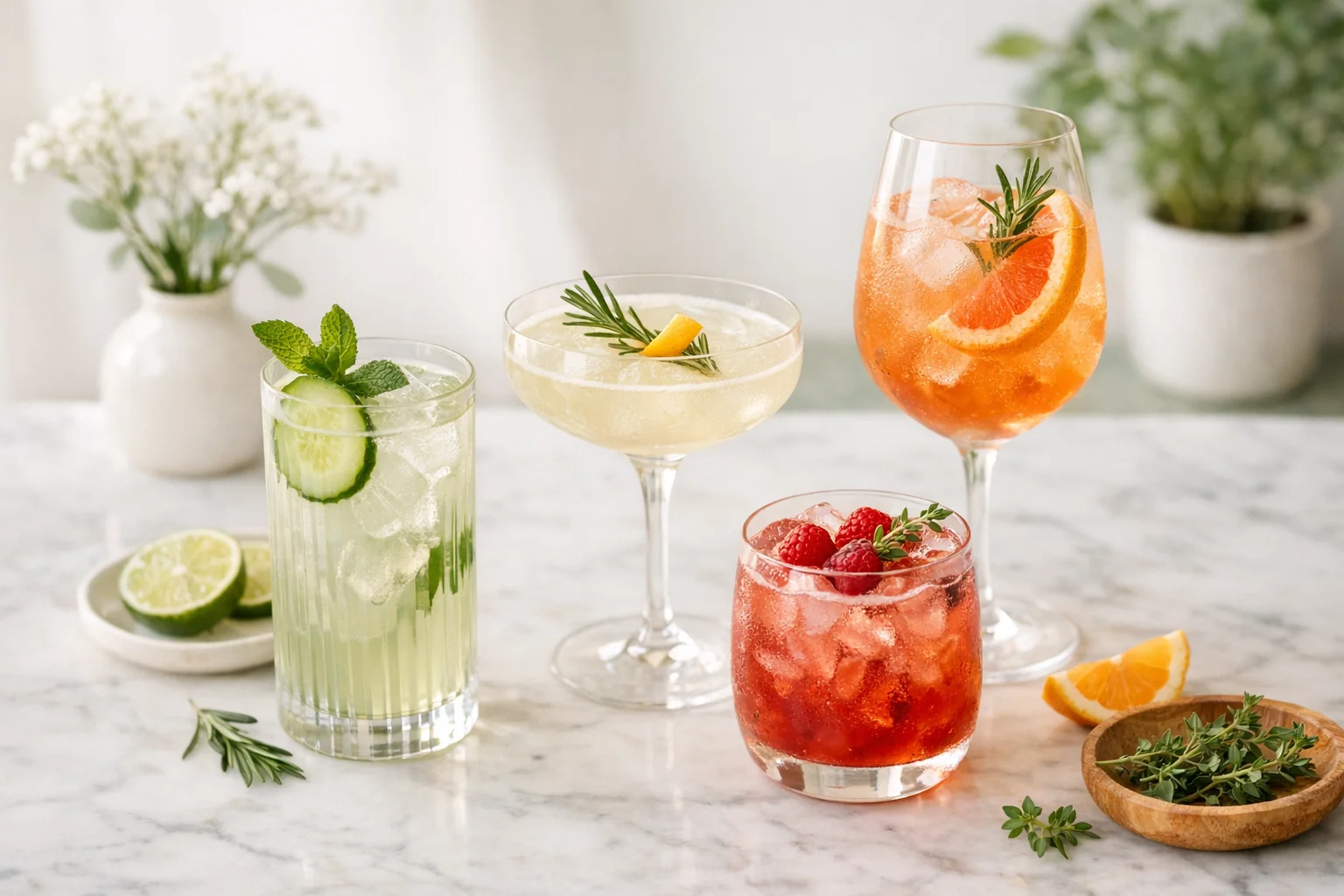
5. A Non-Alcoholic Craft Drink
What to do: Pour yourself something that feels intentional and adult — not just water or juice. Options: non-alcoholic craft beer (Athletic Brewing, Gruvi), NA wine (Surely), botanical spirits (Seedlip, Monday), or functional beverages (Ghia, Kin Euphorics). Serve it in a real glass.
Why it works: Research on habit replacement shows that maintaining the ritual while changing the substance is one of the most effective strategies for behavior change. The glass, the pour, the first sip — these are the components your brain actually craves. Charles Duhigg's research on habit loops suggests that keeping the cue and reward the same while swapping the routine is significantly more sustainable than trying to eliminate the habit entirely. (For a deep dive on the best options, see our tested favorites list.)
Amy's note: I drink more Ghia now than I ever drank wine. It's bitter, herbal, beautiful in a glass, and it completely satisfies the ritual. My go-to: Ghia over ice with a splash of tonic and a grapefruit slice.
6. A Dance Party with Your Kids
What to do: Put on a song your kids love (or one you love — they'll follow). Dance like an idiot for three minutes. That's the whole strategy.
Why it works: Movement triggers endorphin and dopamine release — the same neurochemicals that alcohol artificially activates, but without the rebound crash. A study in Frontiers in Psychology (Tarr et al., 2014) found that synchronized movement (like dancing together) additionally boosts social bonding through endorphin release. You get a dopamine hit, your kids get a connected moment with you, and the cortisol that was driving your craving gets metabolized through the physical activity.
Amy's note: Our current rotation is "Shake It Off" (obviously), "Happy" by Pharrell, and whatever my 8-year-old is obsessed with this week. Three songs = nine minutes = craving gone.
7. Call or Voice-Message a Friend
What to do: Call someone or send a voice message. Not a text — actual voice. It takes 90 seconds to leave a voice message saying "Just calling to say hi, thinking of you."
Why it works: Hearing another person's voice — or even producing your own voice directed at someone specific — stimulates oxytocin release, which directly counteracts cortisol. Research by Seltzer et al. (Proceedings of the Royal Society B, 2010) found that children's cortisol levels dropped significantly after hearing their mother's voice compared to receiving a text message. The mechanism works for adults too: vocal connection is a uniquely powerful stress reducer because it activates brain regions associated with safety and social bonding.
Amy's note: I have a friend who I voice-message every day at 5:30. We call it our "instead of wine" check-in. Some days it's a vent. Some days it's a joke. It always helps. (If you're worried about how friends will react when you change the dynamic, I wrote about navigating that pressure — it's more manageable than you think.)
8. Magnesium Supplement
What to do: Take 200-400mg of magnesium glycinate with a glass of water in the late afternoon or early evening. (Talk to your doctor first, especially if you take other medications.)
Why it works: Magnesium is a cofactor in GABA receptor function — the same calming neurotransmitter system that alcohol hijacks. Regular drinkers are often magnesium-deficient because alcohol increases magnesium excretion through the kidneys (Romani, Archives of Biochemistry and Biophysics, 2011). A study by Boyle et al. (Nutrients, 2017) found that magnesium supplementation reduced subjective anxiety in adults with low magnesium levels. Think of it as supporting the calm that alcohol was artificially providing, but through a mechanism your body actually needs.
Amy's note: I take magnesium glycinate around 5 PM. I genuinely feel a difference in my evening baseline — less edgy, more grounded. It's not dramatic, but it's consistent.
9. Ten Minutes Alone in the Car
What to do: After pickup, sit in the car in your driveway for ten minutes before going inside. Sit in silence, listen to a podcast, scroll your phone — whatever you want. The point is: you're alone.
Why it works: The wine craving is often a proxy for a boundary need. You need a moment that belongs to you before the evening onslaught begins. Research on maternal burnout identifies lack of personal autonomy as a primary driver. Ten minutes of intentional solitude isn't selfish — it's regulatory. You're giving your nervous system a chance to downshift before the demands resume.
Amy's note: I told my husband I need ten minutes in the car after pickup before I come in. He thought it was weird at first. Now he does it too.
10. Journal Dump
What to do: Set a timer for five minutes. Write everything that's in your head — no structure, no sentences, no punctuation required. When the timer goes off, close the notebook. Done.
Why it works: Psychologist James Pennebaker's research at the University of Texas (published in Advances in Experimental Social Psychology, 1997) demonstrated that expressive writing reduces physiological stress markers, including cortisol and blood pressure. The mechanism: externalizing thoughts onto paper reduces the cognitive load of carrying them in your working memory. You're essentially offloading the mental noise that makes the craving feel urgent. Pennebaker's studies found that even five minutes of unstructured writing produced measurable stress reduction.
Amy's note: I keep a cheap spiral notebook in the kitchen drawer. Nobody reads it, including me. It's not journaling in the pretty-notebook-with-prompts sense. It's dumping. And it works.
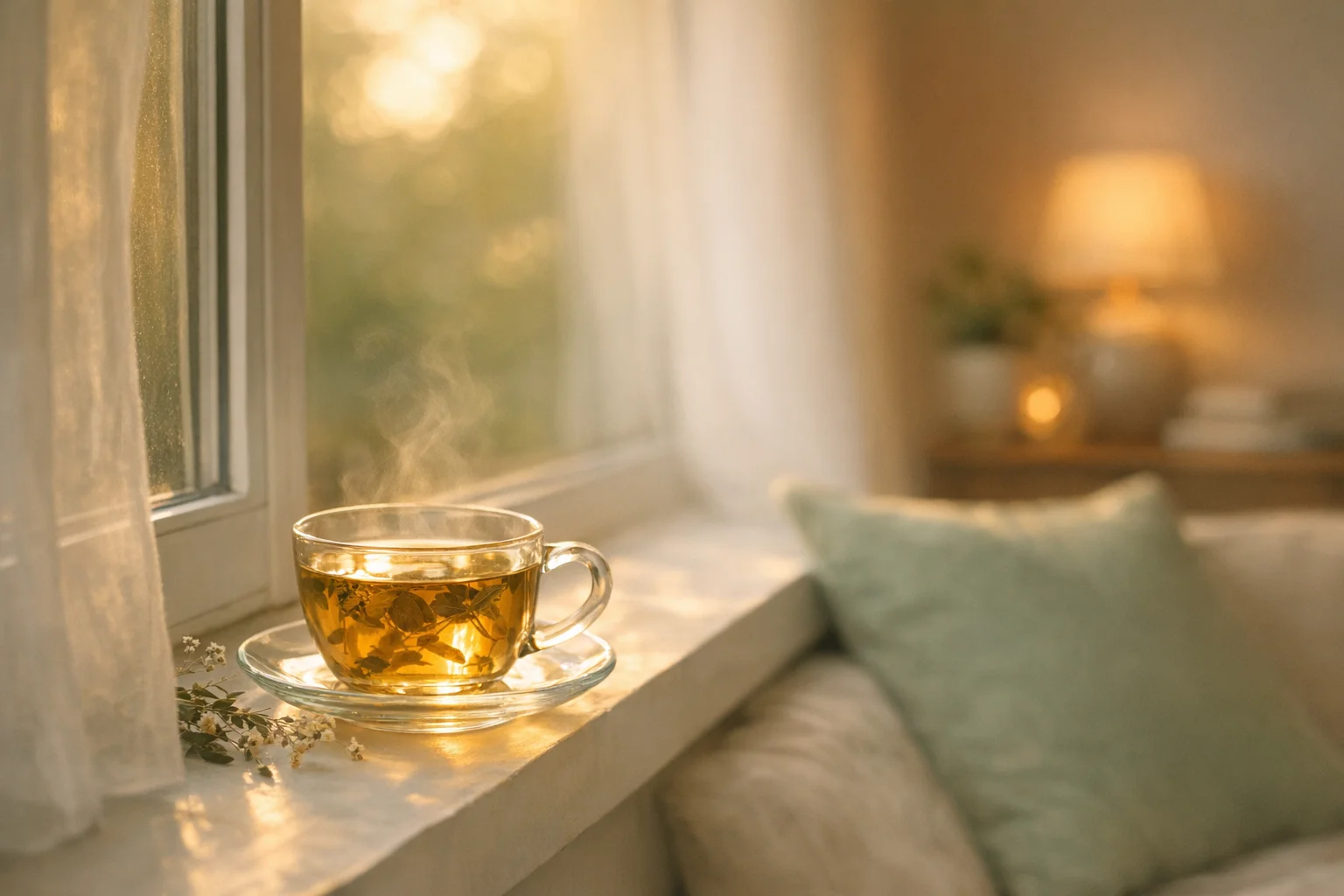
11. A Specific Tea Ritual
What to do: Make a specific cup of tea — not just any tea, but one you've chosen intentionally for this moment. L-theanine-rich options: matcha, gyokuro, or high-quality sencha. For evenings: chamomile, passionflower, or rooibos. Use a kettle, a real mug, the whole ritual.
Why it works: L-theanine, an amino acid found in tea leaves, promotes alpha brain wave production — the brain state associated with relaxed alertness. A study by Nobre et al. (Asia Pacific Journal of Clinical Nutrition, 2008) found that even 50mg of L-theanine (about one cup of green tea) produced measurable increases in alpha wave activity within 30 minutes. The ritual of making tea also serves as a behavioral substitution: boiling water, steeping, waiting — these steps create a transition ceremony similar to the wine-pouring ritual, but without the neurological cost.
Amy's note: I invested in one really good tea that I only drink at this time of day. It's my signal. My brain knows: kettle on = transition beginning. It took about two weeks for the association to form, and now it's as automatic as the wine craving used to be.
12. Change Your Scenery
What to do: Move to a different room. Go to the backyard. Sit on the front porch. If you usually pour wine in the kitchen, don't be in the kitchen at 6 PM. Take a blanket to the living room floor. Move the dinner prep to a different counter.
Why it works: Environmental cues are one of the strongest habit triggers. Neuroscience research on context-dependent memory and habit formation (Wood & Neal, "A New Look at Habits and the Habit-Goal Interface," Psychological Review, 2007) shows that habits are tightly bound to the physical environment where they're performed. Changing your physical context disrupts the automatic cue-response pattern. You're not fighting the craving with willpower — you're removing the trigger that starts it.
Amy's note: I started spending the first 20 minutes after pickup in the backyard instead of the kitchen. The kids play, I sit on the step with my tea, and by the time we go inside to start dinner, the craving window has passed. Such a small change. Such a big difference.
The Deeper Shift: From Escape to Transition
Here's the insight underneath all twelve of these alternatives: the wine craving at 6 PM is your body's legitimate signal that it needs something. It needs a transition. A boundary. A moment of regulation after a long, depleting day.
Wine provided that — at a cost. Each of these alternatives provides it without the anxiety rebound, the sleep disruption, the foggy morning, and the guilt loop. They work with your nervous system instead of against it.
You don't need to use all twelve. Find the two or three that click for you and rotate them. The craving will still show up — especially in the first few weeks. But it will peak and pass within 15-20 minutes if you give it something else to work with.
And then one evening, you'll realize the craving didn't show up at all. Not because you're "fixed" — but because your brain has learned a new pattern. That's neuroplasticity in real time. That's the shift.
For the deeper science behind why alcohol creates the anxiety loop that makes 6 PM so hard, read about how your nervous system processes alcohol. For specific drink recommendations to replace the wine ritual, see our tested favorites list. And if you're also dealing with the compounding effects of maternal burnout, those science articles will give you context for what you're experiencing. For the full map of how the 6 PM craving connects to next-day anxiety and the night's sleep, see our pillar on the three-system loop that keeps you stuck.