Alcohol disrupts your sleep architecture in three predictable phases: a GABA-driven deep-sleep surge (hours 0-3), a glutamate rebound that wakes your nervous system (hours 3-5), and a premature cortisol spike that fragments the rest of the night (hours 5-8). This cascade is why two glasses of wine reliably produce a 3 AM wake-up, truncated REM sleep, and a morning that feels like you barely slept. The total time in bed looks fine; the architecture beneath it is wrecked.
I used to think I slept fine after wine. I'd pour two glasses of pinot around 8 PM, fall asleep on the couch by 10, and congratulate myself on how quickly I drifted off. Then at 3:12 AM, there I'd be: heart thudding, mind cataloging every unfinished task, staring at the green glow of my bedside clock as it ticked toward 4. I blamed perimenopause. I blamed my kids' sleep schedules. I blamed stress. It took me two years to blame the wine.
What I eventually learned is that alcohol doesn't just "disrupt sleep." It hijacks the entire architecture of how your brain cycles through sleep stages, in a sequence so predictable you could set a clock by it. This post maps that sequence hour by hour, because understanding exactly what was happening behind my 3 AM wake-ups was the thing that finally made me stop negotiating with myself about whether two glasses were "really that bad."
What Sleep Architecture Actually Means
Healthy sleep follows a repeating 90-minute cycle of four stages. N1 is the light, drowsy transition. N2 is true sleep onset, where your brain begins consolidating short-term memories. N3 is deep slow-wave sleep, the stage where your body repairs tissue, strengthens immune function, and clears metabolic waste from the brain. REM (rapid eye movement) sleep is where your brain processes emotions, integrates learning, and produces dreams.
You cycle through these stages four to six times per night, but the composition shifts as the hours pass. Early cycles are dominated by N3 deep sleep. Later cycles are REM-heavy. This architecture matters because disrupting the second half of your night disproportionately destroys your REM sleep. And that is exactly what alcohol does.
The GABA Flood: Why Alcohol Knocks You Out (Hours 0-3)
When you drink, ethanol enhances the activity of GABA-A receptors (your brain's primary inhibitory system) while simultaneously suppressing glutamate signaling via NMDA receptors. The combined effect is a powerful sedative wave that reduces how long it takes to fall asleep and consolidates slow-wave sleep in the first few hours of the night.
Research by Ebrahim et al. published in Alcoholism: Clinical and Experimental Research (2013) found that alcohol at all doses increases N3 deep sleep in the first half of the night. On the surface, this looks beneficial. More deep sleep should mean better rest.
The trade-off is steep. A 2025 meta-analysis by Gardiner et al. in Sleep Medicine Reviews, analyzing 27 studies, found that alcohol delays REM onset by approximately 30 minutes for every 1 g/kg of ethanol consumed. Your first REM period, which normally arrives around the 90-minute mark, gets pushed back or skipped entirely. You're logging more deep sleep, but at the direct expense of REM, and driven by a chemical sedative rather than your brain's own regulation.
Here's what that looks like on a clock. Say you finish your second glass of wine at 9 PM and fall asleep at 10:30. Your brain drops quickly into N3 deep sleep. By midnight, you've logged an unusually large block of slow-wave sleep. But your first REM period, which should have started around midnight, hasn't arrived. Your brain's own sleep-staging system has been chemically overridden.
Meanwhile, your liver is clearing ethanol at roughly one standard drink per hour. By 12:30 or 1 AM, blood alcohol is falling fast. And that's when the second phase begins.
The Glutamate Rebound: Why You Wake Up at 3 AM (Hours 3-5)
While alcohol was enhancing GABA and suppressing glutamate, your brain was doing what it always does: compensating. It downregulated GABA receptor sensitivity and upregulated NMDA glutamate receptors to maintain its excitatory-inhibitory balance. Research by Becker and Mulholland, published in the Handbook of Clinical Neurology (2014), describes the resulting "hyperglutamatergic state" that emerges as alcohol clears the system.
As blood alcohol drops below the threshold that was holding your glutamate system in check, the compensatory changes are suddenly unmasked. Glutamate floods NMDA receptors that have become hypersensitive. Your nervous system shifts from chemically sedated to chemically hyperexcitable in what feels like a switch being flipped.
This is the 3 AM wake-up. It isn't random. It's the predictable neurochemical consequence of the timeline your liver sets. If you had your last drink around 9 PM, your liver has spent roughly five to six hours clearing the alcohol. By 3 AM, blood alcohol is approaching zero, the GABA enhancement is gone, and the glutamate rebound peaks.
What does this feel like? Racing heart. Mind spinning. A sense of alertness that feels almost electric, though you're exhausted. You lie there for 45 minutes or an hour before drifting back into shallow, fitful sleep. The REM period your brain was supposed to enter hours ago may finally arrive, but truncated and fragmented. Roehrs and Roth, in a review for the National Institute on Alcohol Abuse and Alcoholism (2001), described this second-half pattern as a combination of increased wakefulness, lighter sleep stages, and disrupted REM architecture.
The anxiety component is real, too. Glutamate hyperexcitability doesn't just wake you up; it activates your amygdala and produces diffuse dread that has nothing to do with your actual circumstances. If this sounds familiar, the anxiety-drinking cycle explains the overlapping mechanism in detail.
The Cortisol Spike: Why the Rest of the Night Is Ruined (Hours 5-8)
The final phase involves your HPA axis, the stress-response system that controls cortisol release.
In normal sleep, cortisol follows a tightly regulated circadian pattern. It drops to its lowest point around midnight, then rises gradually through the early morning hours, peaking just before you wake. This gradual rise helps you transition from sleep to wakefulness feeling alert but not wired.
Alcohol disrupts this timing. Research by Blaine et al. in the Canadian Journal of Psychiatry (2016) found that binge-level drinking increases blood cortisol, norepinephrine, and other stress hormones. Stephens and Wand, writing in Alcohol Research: Current Reviews (2012), documented that this HPA axis activation produces a cortisol spike hours earlier than its natural circadian rise.
So at 4 or 5 AM, when cortisol should still be low and your body should be cycling through its most REM-rich sleep, your HPA axis has already fired. Cortisol is surging. Your sympathetic nervous system is engaged. You either wake up again or drift through N1 and N2 light sleep without the restorative REM cycles that normally dominate this window.
By 6:30 AM, when your alarm goes off, you've technically spent eight hours in bed. Your sleep tracker might say you slept seven of them. But the architecture of that sleep was fundamentally compromised. The first half was artificially deep but REM-deprived. The second half was fragmented by glutamate rebound and premature cortisol. Eight hours of alcohol-affected sleep can leave you more tired than six hours of clean sleep.
What My Sleep Tracker Actually Showed
I didn't fully believe any of this until I saw it in my own data.
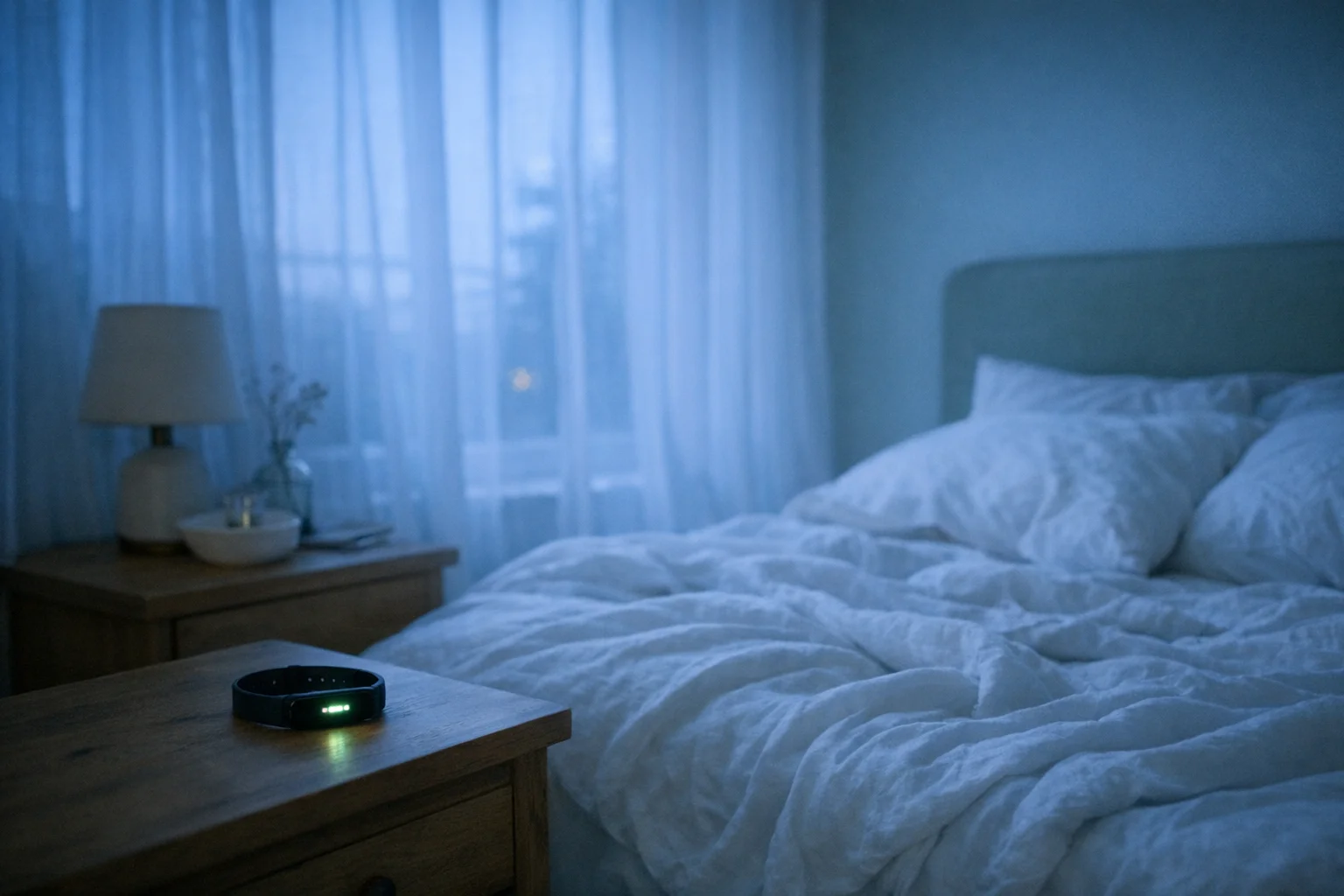
For about three weeks last spring, I wore my fitness tracker religiously and logged everything. Two nights told the whole story: a Thursday (two glasses of pinot noir with a neighbor, last sip around 8:45 PM, lights out at 10:30) and the following Tuesday (same bedtime, same wind-down routine, no alcohol).
Thursday night, the drinking night: I fell asleep in 11 minutes. My tracker logged 1 hour 42 minutes of deep sleep, which looked impressive on the summary screen. But REM sleep was 38 minutes total. My normal is around 90 to 100 minutes. I had three wake periods between 2:30 and 5 AM, totaling 47 minutes awake. My resting heart rate, which usually drops into the low 50s overnight, stayed at 68 for the first four hours. My heart rate variability, a measure of nervous system recovery, was 23 ms. My average on sober nights is 48 ms.
Tuesday night, the sober night: I fell asleep in 19 minutes (a bit longer, and that used to bother me). Deep sleep was 1 hour 18 minutes, which was less than the drinking night. That surprised me at first. But REM sleep was 1 hour 37 minutes. Zero wake periods after falling asleep. Heart rate dropped to 52 by midnight. HRV was 51 ms.
Same bed. Same woman. Same pillow, same thermostat setting. The variable was wine.
That comparison was what stopped me from negotiating with myself about whether two glasses "really affected" my sleep. The data made the invisible visible. I've heard similar stories from other readers here at The Clear Mom, and I think seeing your own numbers cuts through ambiguity in a way that even good research summaries sometimes can't.
Does the Type of Drink Matter?
Not meaningfully. The compound disrupting your sleep architecture is ethanol, which is chemically identical whether it arrives in a glass of cabernet, a craft IPA, or a shot of tequila. A standard glass of wine (5 oz at 12% ABV) contains the same ethanol as a 12 oz beer at 5% or a 1.5 oz pour of spirits at 40%.
The 2025 meta-analysis by Gardiner et al. found no significant difference in sleep architecture disruption between types of alcoholic beverages at equivalent ethanol doses. What matters is total dose relative to body weight.
One myth worth addressing directly: the idea that red wine helps sleep because it contains melatonin. Red wine does contain trace melatonin from grape skins, but the concentration is orders of magnitude below therapeutic doses. A glass of red wine contains roughly 60 to 120 nanograms of melatonin; a standard supplement contains 1 to 3 milligrams. The ethanol in that glass, however, is more than sufficient to suppress REM sleep for the entire night.
For women approaching or in perimenopause, the dose-response is even steeper. Lower gastric alcohol dehydrogenase activity and shifting hormone levels mean the same two glasses produce higher peak blood alcohol and more pronounced sleep disruption than they did a decade ago.
How Long Until Your Sleep Architecture Recovers?
The recovery timeline is faster than most people expect, and understanding it helped me get through the first rough nights.
Roehrs and Roth (2001) found that tolerance to alcohol's sedative effects develops within just three consecutive nights of drinking. By night three, you're getting less of the "knock me out" benefit but still paying the full price in glutamate rebound and cortisol disruption. Diminishing returns with constant cost.
The reverse is also encouraging. When you stop, the first two or three nights can feel worse as your brain's compensatory systems overshoot. Sleep onset may take longer. You might experience unusually vivid dreams as REM sleep rebounds hard. But by nights four and five, most people notice distinctly better sleep quality.
Colrain, Nicholas, and Baker, in a review published in the Handbook of Clinical Neurology (2014), documented that sleep architecture begins normalizing within one to two weeks of abstinence, with REM patterns showing the most dramatic improvement. Deep sleep consolidation and sleep continuity follow. By 30 days, most regular drinkers experience sleep architecture that is substantially recovered. For the full brain recovery timeline, see what happens to your brain after 30 days without alcohol. The sleep disruption mapped here is also one piece of a larger pattern, traced in our pillar on the three-system loop of alcohol, anxiety, and sleep.
I noticed the shift around day 12. The 3 AM wake-ups, which had been such a fixture of my nights that I'd stopped even questioning them, simply stopped. I slept through to my alarm for four consecutive nights that week. It felt like recovering something I'd forgotten was mine.
When I was trying to make sense of this research and actually apply it to my own evenings, the daily neuroscience lessons in the Reframe app gave me a framework I could use. Each lesson connected a specific mechanism (like the glutamate rebound) to a practical response, and the drink tracker helped me see the correlation between my sleep data and my drinking patterns over weeks. It was the tool I kept returning to, though your path may look different.
Understanding what alcohol does to sleep architecture changed my relationship with my evening wine more than guilt or willpower ever did. The 3 AM wake-up isn't random. The morning exhaustion isn't inevitable. They're the predictable output of a neurochemical sequence that starts the moment ethanol hits your GABA receptors. Once you see the mechanism, you can't unsee it. And for me, that was the beginning of sleeping through the night again.