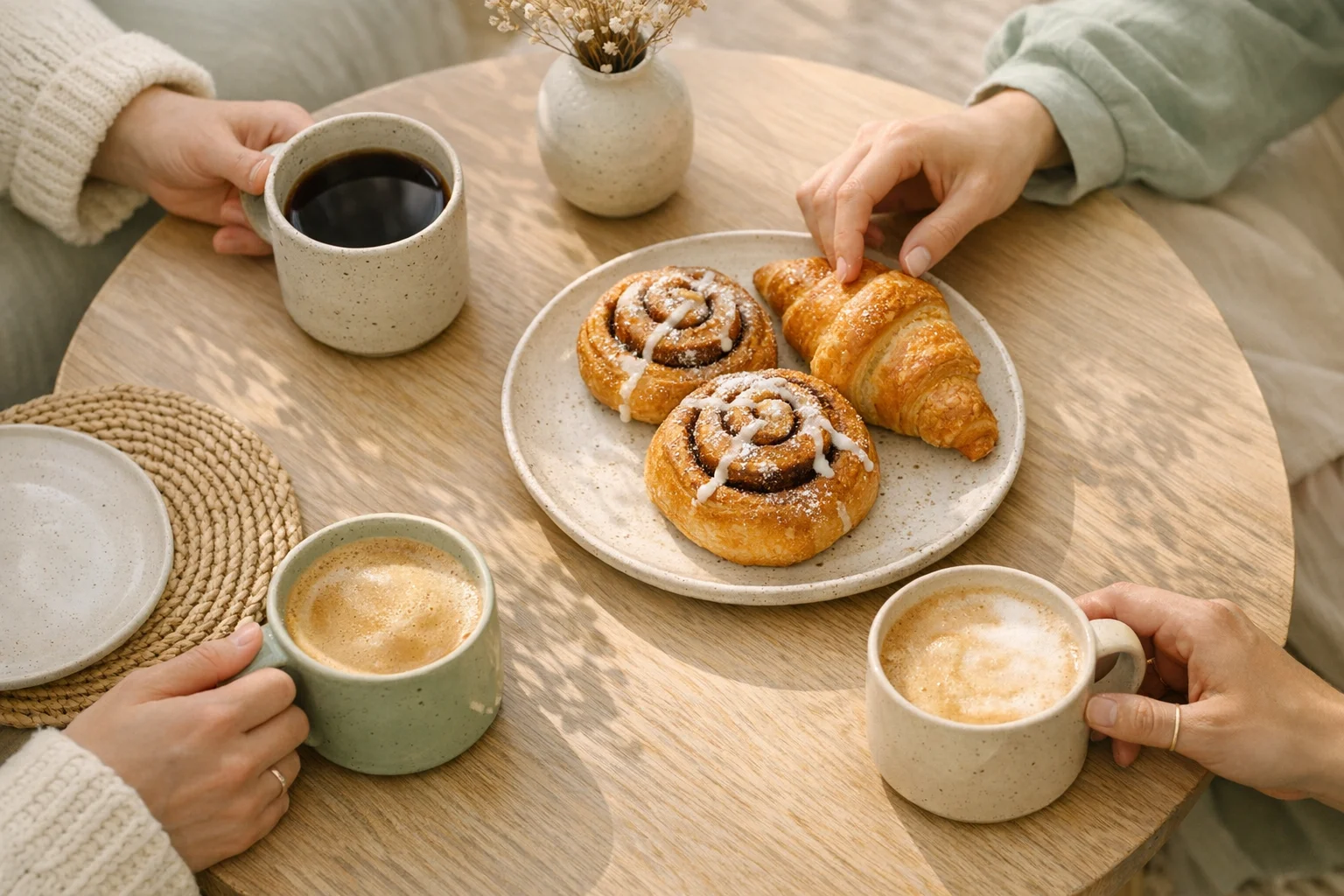
Grey area drinking is the pattern of regular, moderate drinking that sits between casual social drinking and clinical risk drinking. It is the nightly glass of wine, the second pour you did not plan on, the quiet internal argument over whether tonight counts. It is not a diagnosis but a position on a spectrum, and roughly one in seven American adults sits inside or just past it.
There is a specific kind of moment I want to describe. It is 5:48 PM on a Thursday in March. The pasta water is on. The youngest is doing math at the table. And I am standing at the wine fridge having a conversation with myself that I have had a thousand times. Tonight or not tonight. Just one or the kind of one that becomes two. The bottle is open from yesterday and there is exactly enough left for a generous pour. The math is doing itself. I have not actually decided anything, and the cork is already out.
That moment has a name now. It is grey area drinking. Once I had the language, I could not unsee it in any of the mothers around me.
Grey Area Drinking, Defined
What is grey area drinking? It is the pattern of moderate, regular drinking that sits between casual social drinking and clinical risk drinking. The nightly glass of wine. The two beers most weeknights. The Friday "split a bottle" that became a Tuesday "split a bottle" without anyone marking the day.
The phrase itself was popularized by health coach Jolene Park in a 2015 TEDx talk. She used it to name something a lot of women already knew. There are people who do not have a rock-bottom story, who would never check a box that says "alcoholic," and who also know, quietly, that their drinking is not serving them. That gap between the lived experience and the available labels was the whole problem. Park gave it a vocabulary word.
Researchers had been describing the same territory for years in less catchy language. Dawson and Grant, in a 2011 paper in the Journal of Studies on Alcohol and Drugs, mapped what they called the "gray area" between moderate guidelines and risk thresholds. People who drink in that zone, they found, carry a small but measurable elevated risk of dependence. Importantly, 89 to 94 percent of grey-area drinkers who experienced any alcohol-related harm subsequently exceeded the moderate guidelines. The middle zone is not a stable address. It tends to drift.
The Spectrum: Where Grey Area Drinkers Actually Sit
Imagine a horizontal line. On the far left, people who do not drink. Just inside of them, occasional social drinkers, the friend who has one beer at the cookout twice a year. In the broad middle, regular moderate drinkers, the people who have a glass or two most nights without thinking much about it. To the right of them, heavier drinkers who consistently exceed weekly guidelines. On the far right, severe clinical drinking, the picture most people imagine when they hear "alcoholic."
Grey area drinkers sit in the middle band, sometimes drifting toward the right. They are not abstainers. They are not "social drinkers" in any meaningful sense, because the drinking is not social anymore. It is simply present. They are not clinically diagnosable in most cases. They are, in a word, regular.
The binary frame ("alcoholic or not an alcoholic") erases the entire middle of the line. Hasin and colleagues, in the 2013 paper that produced the DSM-5 criteria for substance use disorders, formally recognized this. They consolidated the older "abuse" and "dependence" categories into one Alcohol Use Disorder with explicit severity dimensions: mild (two to three criteria), moderate (four to five), severe (six or more). The DSM-5 is, in effect, an acknowledgment that drinking problems live on a continuum, not on one side of a wall.
Grant and colleagues, in NESARC-III (2015), surveyed more than 36,000 US adults and found 13.9 percent met criteria for past-year AUD and 29.1 percent met criteria at some point in their lives. Most of those cases were mild or moderate, not severe. The mathematical center of mass of "people with a drinking problem" is not the rock-bottom drinker. It is the regular, moderate, quietly questioning one.
Why Nightly Moderate Drinking Builds Its Own Pattern
The neurochemistry of nightly moderate drinking is different from the neurochemistry of binge drinking, and this is the part most explainers skip. Binge is a flood. Nightly moderate is a slow tide.
A single drink boosts GABA, your brain's main calming neurotransmitter, within ten to twenty minutes. That is the "wine takes the edge off" effect. It is real, and it is temporary. As the alcohol clears, glutamate (the excitatory counterpart to GABA) rebounds upward. On a single occasional drink, the rebound is small enough that you barely notice. On a nightly drink, repeated for weeks and months, the brain starts to expect the GABA boost. Kumar and colleagues, in a 2009 review in Psychopharmacology, documented how chronic alcohol exposure reshapes the GABA-A receptor itself, internalizing the most sensitive subunits and trafficking less responsive ones into their place. The brain is adapting. It needs more alcohol to produce the same calm, and it produces more glutamate excitement on its own to compensate.
Becker and Mulholland (2014) called this a hyperglutamatergic state. The brain has quietly recalibrated around the assumption that alcohol will be in it most evenings. On a night you skip, the GABA is not boosted on schedule, the glutamate is still elevated, and the result is a low-grade restlessness, a harder time falling asleep, and a 3 AM wake-up that feels like a personality trait. The full nervous-system loop behind the anxiety-drinking cycle covers the mechanism in more depth.
This is the trap of nightly moderate drinking. It does not look like a problem because each individual drink is small. The problem is the cumulative reshaping of the system that the small drinks are quietly producing.
How Mommy Wine Culture Hides Grey Area Drinking in Plain Sight
Grey area drinking would be hard enough to notice in any context. Inside motherhood, it is almost impossible.
Freisthler and Wolf, in a 2022 longitudinal study in Alcohol and Alcoholism, followed mothers through three waves of the pandemic. Drinks per drinking day rose from 1.28 in spring 2020 to 1.41 a year later, and remained elevated at 1.36 in spring 2022. A roughly nine percent increase in drinks per occasion, sustained across two years. None of the mothers in that sample were necessarily binge drinking. They were having a slightly bigger pour, slightly more often, and the new baseline did not come back down.
Around them, the culture was applauding. The "Wine o'clock" mug. The "Mommy needs a moment" tee shirt. The class group chat that started joking about wine at 4 PM on a Tuesday. The broader mommy wine culture that normalizes nightly drinking is not a separate problem from grey area drinking. It is the social wallpaper that makes grey area drinking invisible to the women living in it.
When everyone around you drinks the same way you do, there is no external signal that the pattern has crept. The social pressure I felt at playdates and book clubs was not loud. It was the quiet kind. The kind that tells you a person who does not pour the chardonnay is making a statement. Grey area drinking thrives in cultures that reward not noticing.
Am I a Grey Area Drinker? A Reflective Self-Check
What follows is not a quiz. It will not give you a score. It will not tell you whether you do or do not have a problem. It is a list of small, honest questions designed to help you notice patterns the binary "alcoholic or not an alcoholic" frame is built to hide.
Read them slowly. There are no right answers.
- Has the time of your first drink quietly moved earlier in the year, by even thirty minutes?
- Have you poured a "just a splash" refill and then poured another without consciously deciding to?
- When you imagine a full week without any alcohol, does your stomach drop a little before your brain answers?
- Have you started buying wine in larger format containers (boxes, magnums) than you used to?
- Has your typical pour quietly grown, while you still call it "a glass"?
- Do you feel a small bargaining around 5 PM about whether tonight is or is not a drinking night?
- Have you noticed your sleep changing on the nights you drink versus the nights you do not?
- When a friend mentions she is taking a break from alcohol, do you feel relieved that she went first?
- Have you cancelled or shortened a morning plan because of last night's wine?
- Does the phrase "I am not an alcoholic" show up in your own head more often than it used to?
If several of those questions made you pause, you are not in trouble. You are paying attention. That is the only diagnostic posture I trust here.
My Own Spectrum, Over Time
I have lived in several places on this line. It feels worth showing the arc, partly because I think the spectrum frame is more accurate than the binary, and partly to make a point: where you are now is not where you have to be.
In college I was a binge drinker. Four or five drinks on a Friday, Sunday-morning regret, nothing nightly. Through my late 20s I was a social drinker in the genuine sense. A glass at dinner with friends, weeks at a stretch with nothing in the house. Then I had three children in five years. Somewhere around the second baby's first birthday, the nightly glass started. It was not a decision. It was a thing that just was, the way a kitchen rug is.
By 36 I was the person at the wine fridge at 5:48 PM having the same internal argument from the top of this post. I was not bingeing. I was not missing pickups. I was, in retrospect, in the middle band, drifting gently right. By 38 I had started questioning it, mostly internally, and I told no one. By 41 I was in the rethinking phase this site documents. Now, at 43, I am somewhere without a clean label. Drinking on a fraction of the nights I used to. Noticing a lot more.
Position on the spectrum is not identity. The drink that used to be invisible can become visible again, and once it is visible the relationship to it can change.
What I Did When I Started Paying Attention
Naming the pattern was step one and probably most of the work. The rest was small.
I started measuring my pours with an actual five-ounce wine glass instead of the seven-ounce one I had been calling "regular." I wrote the actual count of drinks per week down somewhere, instead of estimating it in my head, where the estimate had always run quietly low. I moved my last drink earlier in the evening so my body had a longer window to clear it before sleep. I read what recent research actually says about moderate drinking and updated my mental model accordingly.
When I started paying attention more deliberately, I needed something that treated me like a person curious about her own brain, not a person who needed to be labeled. Reframe was the first tool I tried that did not feel like it was shaming me. The daily neuroscience lessons read as an invitation, not a verdict. It is not the only tool that can do that, but it was the one I kept opening at 9 PM when the kids were down.
Annie Grace's free 30-day Alcohol Experiment is another low-friction starting point if an app is not your style. SMART Recovery offers structured peer meetings online for people who want a community piece without a 12-step framing. Individual therapy or motivational interviewing with a qualified clinician is another good route, especially if anxiety or depression is sitting underneath the drinking.
I write on The Clear Mom because I wish someone had handed me the spectrum frame, the neurochem, the cultural context, and a list of small honest questions ten years ago. Not to make me feel bad. To give me language. The label was never the obstacle. The lack of language was.
This post is written from personal experience and cites peer-reviewed research. It is not medical advice. If you're concerned about your drinking or your health, please speak with a qualified clinician.